Slice-of-life/romance short. A journalist goes out to do a small piece on everyday farmlife, and ends up meeting an old acquaintance from school.
4.3k, M/M, rated T. Just a light-hearted little window into two men’s lives, introducing Melodious King and Calumellus Renn. Please note warnings for self-harm, references to attempted suicide, mental illness including chronophobia, and bullying and homophobia.
It was a warm summer’s day, and the sunshine came in bright through the window into the little farmhouse. It was warm, but because of the stone walls of the old cottage, the air felt surprisingly light and non-oppressive compared to how he’d felt in the car on the way up, even with the air conditioning on.
Calumellus had just finished recording on his phone, and had set his phone aside — he liked to record interviews at the same time as he took a few notes, but there really hadn’t been that much to actually talk about. He’d arrived earlier in the morning, and had walked around the farm and taken a few photographs of Mrs King — Livid — with her sheep and the dogs.
Livid had invited him to sit and eat with them as they’d conducted the rest of the interview, which Calumellus had been grateful for, because there really wasn’t that much to talk about. It wasn’t as if he didn’t respect farming, just that there wasn’t exactly much to report on: this was just a slice-of-life piece, really, a little window into a lifestyle that wasn’t exactly commonly known for most people in Lashton.
Around the table were Livid, her wife Shoshanna, and one of their sons, Devout, who was an eighteen-year-old that still worked on the farm with them, although he tended more to their flower crop than he did the sheep. Their daughter, Mirthful, was studying Ag Science at university, and their youngest son, Fruitful, was on a year abroad in Denmark.
“You’re going to drive back to Lashton now?” asked Shoshanna as she started picking up plates from the table, stacking them to bring them over to the sink. Livid had gotten to her feet and was scratching the top of the head of one of her working dogs, who kept looking anxiously toward the door — they liked to work, she said, and wanted to be where the boss was, but didn’t actually like to be idle.
“Uh, yeah, that’s the plan,” said Calumellus.
“Two hours here and two hours back,” she remarked, clucking her tongue. “There’s nothing else in Medalton that might interest you? There’s a few museums in town, there’s the old college… Nothing you might want to report on?”
“I,” started Calumellus, not knowing exactly what to say — she seemed a nice enough woman, and he appreciated that she just wanted him to make the most out of the journey, but he’d drawn the short straw at coming out here in the first place.
“Oh, let him be,” said Livid, pushing open the bottom gate of the barn door and letting her dog rush outside, although he didn’t actually go far, just lingered on the doorstep and looked up expectantly for Livid to follow him back out into the fields. “He’s come out all this way, listened to two old bags talk his ear off for four hours. I expect he’s had enough.”
Calumellus pressed his lips together to keep from laughing, but he did smile. “I never thought of you as old, Mrs King.”
“Journalists make great liars,” she told her son, who laughed, and Calumellus chuckled, shaking his head.
“You might as well go out to talk to Melodious, too,” insisted Shoshanna, turning around from the sink and looking at him seriously. “If you want a window into different parts of life on the farm, anyway, he does differently again to what we or Devout do.”
“He doesn’t want to talk to Melodious,” said Livid, but she was very wrong — Melodious King rang a distant bell in his head, sounded familiar, although he couldn’t quite remember why.
“What does Melodious do?” he asked.
“He keeps bees,” said Shoshanna. “And he brews, too — he makes mead, some beers, a sort of honey ale, and a few other things, too. Half of the money Devout makes at the market is from what Melodious makes, not the flowers themselves.”
“Not quite half,” muttered Devout. “But, yeah, maybe forty percent.”
“Okay,” said Calumellus. “Yeah, I’ll talk to him. He’s around?”
“He’s always around,” said Devout, getting to his feet. “I’ll point you the right way.”
* * *
Calumellus hadn’t realised in his cursory tour of Gold Keys farm with Livid King that there was even land down this way — because of the way the fields sprawled down the hillside until they met the stream that cut through the property, he hadn’t realised that beyond the field of apple, plum, and pear trees at the bottom of the hill, there were more buildings.
Driving down and pulling up, he got out in a little dirt square: there was another cottage, this one smaller and far more modest than the big farmhouse the rest of the family lived in, and significantly older, he had to guess. It had a thatched roof and was made of bigger slabs of hewn stone, and the windows were made of stained glass in vague geometric patterns.
The cottage was in the middle of two other buildings; the one to the left had its barndoors open, and he saw the tractor inside, an ancient old machine surrounded by other bits and pieces of machinery, old tools, scrap metal; the one to the right also had its door ajar, and when Calumellus moved forward and put his head in, he saw that it was a shed with various bottles, barrels, and stills arranged on the shelves, each of them neatly labelled with dates and numbers, the latter of which he assumed was some kind of reference number.
The room was meticulously arranged, each still with precisely the same distance between it and the next on the shelf, no dust or dirt or similar around, the sink literally shining with how clean it was.
The barn was in a similar state — a lot of the tools were told, visibly looked to be at least fifty if not a hundred years old, but they were all in good condition with no rust or dirt on them.
“Hello?” he called, knocking on the door of the cottage, but there was no answer, and he put his hands in his pockets before moving down a nearby path, further trailing on one side of the field of fruit trees.
They had a chicken coop up at the house, and when he saw the hutch in a small, enclosed yard, he thought that it was another one, but when he looked inside the wire enclosure, he saw a different kind of bird running around, little ones only a little bigger than his fist.
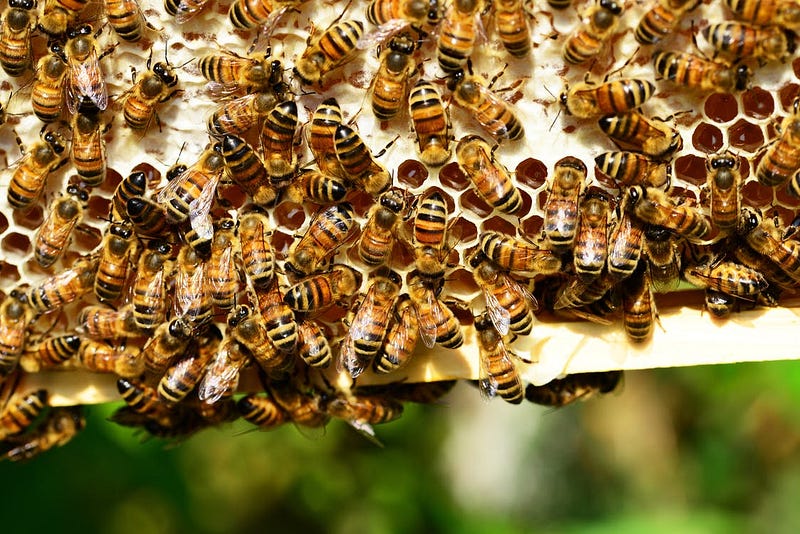
Across a wooden bridge that crossed over the stream, he could see a dozen or so of the square boxes that he only really knew from TV were beehives, and stood at one of them was a beekeeper in the white suit with a veil and hat on, carefully examining one of the frames that he’d pulled out from a hive before he put it back.
He walked away from the hives, back to the path, and Calumellus stood on the other side of the stream as he approached, coming to stand on the bridge. It was only a small thing, just big enough for a man to walk across. He unzipped the back of the suit, letting it fall down around his waist, and Calumellus watched, his mouth dry, as he tied the sleeves around his waist to keep it in place.
He was only wearing a white vest underneath the suit, and up and down his arms Calumellus could see criss-crossing little scars, what seemed like hundreds of them, white and a sort of soft pink-brown that was lighter than his skin, in various stages of having aged.
When he reached up and pulled the veil and hat off of his head, Calumellus saw his face, and suddenly remembered who Melodious King was.
He was beautiful to look at, with high cheekbones and deep-set eyes, his skin a warm brown that took on an olive-green tint under the direct shine of the sunlight, and his dark hair, cropped short, was sun-bleached in places, lighter browns showing under the darker chestnut of its colour.
He remembered going to school with Melodious King — he remembered seeing him sing in school concerts, remembered one time when he’d dressed up in a toga and played a lyre for some event or other, remembered distantly that he’d been on the football team, so that in assemblies he’d be up on stage with the rest of them after they’d won somewhere.
He’d left school early for a modelling career, and for a few years he was always in the paper, or up on billboards around town, or he’d be on some ads here and there, stuff that would get shared in group chats. He’d wanked over Melodious King not irregularly when he was sixteen and unable to look away from his fucking naked perfume ads, but he hadn’t thought about him in years.
“You’re a Renn,” said Melodious by way of greeting. His lips were pressed loosely together, his eyes distant, his expression was blank and disaffected, and his voice was so fucking quiet that Calumellus had to actually strain his ears to hear him, leaning forward slightly and relying on the movement of his lips as much as the sound he made. “Are you here to institute some sort of gang warfare?”
“No,” said Calumellus, swallowing. “No, I’m not, uh, involved with that part of the family — I’m a journalist with the Lashton Gazette. I’m here doing a piece on magical farm life, and your family suggested I come talk to you.”
“Shoshanna suggested that, hm?”
“Yeah.”
“She tries to socialise me, now and then,” said Melodious, holding his veil in his hand as he came closer, his steps quiet but audible on the wooden bridge. He stood in front of Calumellus then, looking down at him, his head tilted slightly to the side — he was taller than Calumellus by nearly a head, and had more muscle on his body than Calumellus did, still looked like an athlete, still looked like a model, even covered in scars. “You and I went to school together.”
“I was two years below you,” said Calumellus, and Melodious nodded slowly.
They stood there for a second, looking at one another, and then Melodious asked in an even, smooth tone, his voice still painfully quiet, “What do you want to know?”
Had he talked this quietly at school? Calumellus didn’t think so — when he’d sung, it certainly hadn’t been quiet, and while he didn’t really remember what his voice had sounded like, he’d talked in assemblies or at concerts, had announced himself or said what songs he was going to sing.
“What happened to you?” asked Calumellus, and Melodious peered down at him with interest.
“What does that have to do with farm life?” he asked, arching his eyebrows, and Calumellus swallowed, looking away.
“Sorry,” he said. “Sorry, um — All I did with Livid was take some photos of the sheep and the chickens, a few of Devout and the flower crop, and talk about what their day-to-day looks like. It’s just a profile, that’s all: a day in the life.”
Melodious nodded his head. “Are you making notes?” he asked.
Calumellus pulled out his phone, showing Melodious it was set to record, and as Melodious led the way back toward the outbuildings, Calumellus followed after him, wondering the whole time if his microphone was actually sensitive enough to pick him up.
* * *
Melodious King woke every morning in the summer with the sunrise, which at this time of the year was around four-thirty or five in the morning. He didn’t know, exactly, because he didn’t use a clock, and only tracked time by the position of the sun — in the winter, he used a sunrise alarm clock to keep him waking up no later than nine o’clock, but even on that, he stuck a piece of tape over the clock’s digital display, so that he couldn’t read the numbers.
He started out the day by feeding his quails and harvesting their eggs, and helping his cousin at the main house if he was needed, especially if the sheep were lambing or it was a market day and he needed help loading the truck. Following this, he inspected all of his hives on a three-day rotating schedule, going between the two plots of hives closest to his house here, and another plot of them on the top of the hill — in the spring, there was a lot of food plentiful for the bees, so the most important part of his inspections, apart from checking them for pests or disease, was to ensure they had enough space for their colonies to expand.
If they didn’t have enough space and were ready to expand, they’d begin to swarm, he said, and if a colony swarmed unexpectedly they could fly too far away for him to trace them or know where they’d gone.
When there was due a swarm, he’d arrange another hive ready for the bees to move into, and he’d pick up the queen and set her in the new hive so that the bees would follow her over, and one hive would become two.
“Each hive has a separate box on top to the main bulk of the hive, where the bees can store excess honey — that way, whatever I harvest from them won’t prevent them from having sufficient stock to survive the winter. If you want to take photographs or video, this process will be the most interesting, I think, other than an inspection.”
He was passionate about the bees, Calumellus thought, and passionate about honey. It wasn’t what he was meant to be thinking of, watching him scrape a sharp knife over the surface of a frame full of honeycomb, removing all the caps from the little honey-filled cells before he placed the frame inside a big tub that could be rotated at speed, using centrifugal force to actually extract the honey.
He talked about them quietly, but very lovingly, described them as hard workers and dutiful members of the colony, and very beautiful, and very intelligent, and very wonderful. He talked about them with a soft smile on his lips even as he turned the crank, spinning the frames inside the extractor, and Calumellus watched with fascination as honey was pumped out into a container.
“You can taste it,” said Melodious. “I need to filter it for wax and any particulates in it, but it’s perfectly safe to eat.”
It was sweet and smooth, had a slight acidity to it that meant the sweetness wasn’t sickly.
After he attended the bees, he went through everything he had brewing, the meads, the ales, the beers, and after lunch, he typically had a nap in the early afternoon. In the early evening, he’d attend to maintenance on anything on the farm that his cousins or aunts didn’t have time to get around to, or he’d go for walks up the hill, toward the mountain.
Every Friday evening, he took a pack on his back and walked up the mountain, and camped there until the following morning.
“Why?” Calumellus asked.
“I find the fresh air is good for my constitution,” said Melodious.
“What about in winter?”
“Air is air, whether it’s hot or cold.”
“In the snow? You camp in the snow?”
“Mm. I wear a coat, of course.”
He didn’t have a television, and he didn’t have a radio. He used spreadsheets on his computers to track his hives and his brewing schedule, and to keep a to-do list of regular maintenance work, but it wasn’t connected to the internet, and he had another piece of tape over the corner of the task bar, so that he couldn’t see the time.
“Livid and Shoshanna bring me books every other week,” he said as he brewed tea. Calumellus was sitting in the armchair beside his fire — his cottage only had one big room, and although there was a ladder upstairs, he just used the attic space to store kegs as they aged. “I sketch. I do a lot of work here on the farm. In the winter, I knit, and I whittle wood — and I foster kittens and puppies from the Medalton animal shelter, when they need someone to step in.”
Calumellus nodded, making a few more notes on the page as Melodious came over.
“You want to ask again,” observed Melodious, pouring from the pot. He took honey in his tea instead of sugar, so Calumellus did too. “What happened to me.”
“You were famous,” said Calumellus.
“Yes,” Melodious agreed. “But when people think of famous Kings, now, they don’t tend to think of me. They think of my cousin Valorous, or any of the musicians, you know, like Cacophonous or Studious or Victoriously Reising. People forgot about me very quickly, when I wasn’t in front of the camera anymore. You’re not going to include this in your report, I hope?”
“No,” said Calumellus, showing him his phone wasn’t recording anymore and demonstratively closing his notebook, and Melodious looked at him. “I’m not — Sorry. We were never even friends — I guess I don’t have the right to ask.”
“I don’t know that the right to ask questions is protected anywhere,” said Melodious. “But it’s a natural instinct, isn’t it?”
Calumellus nodded his head.
“Did you find me attractive?” asked Melodious, and Calumellus stared at him, feeling his lips part.
“I, um…”
“I remember when you came out — you were, what, fifteen? One of the Pikes was giving you grief, and your brother set his hair on fire.”
“Crispus, yeah,” said Calumellus. “He was really nervous about me coming out of the closet, and he basically went on the offensive if anyone so much as looked at me funny. He knew before I did, I think.” He remembered it pretty vividly, being eleven in his new school uniform, and Crispus and Drusilla telling him that if anyone even implied something he didn’t like, if he even felt uncomfortable in a situation, he should run and get one of them.
He didn’t quite understand why until later, until he was about thirteen and he had a crush on Cassian Laithe, who went to the same boxing gym that Calumellus did. He’d helped him during a training session, told him how to adjust his stance, gave him some pointers, and he’d gone home in a haze, only able to think about the chest hair Cassian was starting to grow, and the way his sweat shone on his skin.
Crispus had fought him in the ring, had won against Cassian easily, and Calumellus remembered absolutely flipping his lid and screaming at him for reasons he didn’t get until later, when Drusilla had talked to him about crushes, about attraction, about what love felt like.
“Why did you?” asked Melodious, and Calumellus frowned at him.
“Huh?”
“Why did you come out?”
Calumellus looked at him from across the table leaning back in the armchair.
“I didn’t even come out,” said Melodious. “Not while I was at school — even as a model, I never talked about it, not in public, not to the press, or even to anyone I didn’t know in private. But you did. That was, what, 2003?”
“I didn’t mean to,” said Calumellus. “I was boxing, and someone started spreading a rumour that I was, um, that I was trying to date this girl in the year above, Triss, and even she thought it was true, and she tried to turn me down at lunch, and I just… I said I never wanted to. That she wasn’t exactly my type. And she got angry and offended, asked what was wrong with her, and I just said, you know, that I didn’t… That I didn’t. I was just a stupid teenager, and I was nervous, and everyone was looking at me, and I just, you know, blurted it out.”
“Oh,” whispered Melodious, and looked into the empty fireplace, sipping at his tea. “I thought you were brave.”
“Sorry to disappoint you,” said Calumellus. “So you’re — You’re gay?”
“Bi.”
“Right. But that’s — Better, right? I mean, for being in the closet, ’cause you could still date women, be with them?”
Melodious shrugged his shoulders, running a hand back through his hair, although it was short enough that it barely moved with the touch.
“You used to have it longer,” said Calumellus.
“Yes. It’s really not an interesting story, you know. I modelled a lot, acted a bit, but I couldn’t really cope with the schedules, and, um… The way people touched me. Looked at me. The polite way of putting it is that I had a mental breakdown, made a few attempts at suicide, and Aunt Livid said she’d look after me. I was meant to stay here for a few months, just to get better, and then go back home, back down to London, but I didn’t.”
“I don’t know,” said Calumellus. “Sounds like that could be an interesting story.”
“Not to me. You didn’t answer my question.”
“Which one?”
“I asked if you found me attractive.”
“That was ten years ago,” said Calumellus. “I was fifteen, sixteen — I found certain suggestive shadows attractive, let alone professional models.”
“You did, then?”
“I did,” said Calumellus. “Believe it or not, though, I don’t normally date models.”
“No?”
“No.”
“What about farmers? Apiarists? Brewers?”
Calumellus laughed, turning his head to the side, and he sipped at his tea, tasted the honey in it. “Last guy I dated was a clerical officer at the shipping yard. Before that, um, a shop manager. A flight steward. A guy that designs prosthetics.”
“You get around,” said Melodious softly, and Calumellus shrugged his shoulders, chuckling.
“What about you?”
“I don’t date much,” he said quietly. “I don’t really get out.”
“Not at all?”
“Clocks make me, um… They make me nauseous. Or, not clocks, exactly, but being able to see what time it is, and the passage of time, all of that? If there’s a clock the room, or some way to see the time, like on a phone or a computer, I just can’t concentrate on anything else. I just end up counting the seconds. I don’t go to the market with Devout or Fruitful, because there’s a big clock tower, and there’s the clock display in the pharmacy window — sometimes I go to the Rose in Flower, they know me, and they cover their clock up for me, but not too often, and normally only in the winter when there’s not enough to do.”
“Not many people to meet in the Rose in Flower?”
“Not really,” said Melodious quietly. “And people can’t hear me very well in a pub environment — and they don’t much enjoy straining to hear.”
“You used to talk louder.”
“I did.”
“Do you still sing?”
“Sometimes,” said Melodious. “To the bees.”
“Do they like that?”
“I don’t know,” said Melodious, looking thoughtful. “I think so. They don’t dislike it, in any case — or not enough to cause me any harm. I don’t know that they know the difference between me talking to them and singing. It’s all the same to them.”
“Can I put that in the article?”
Melodious chuckled, and then he nodded. “Yes, if you like. I don’t expect that it’ll do any harm for you to tell your readers that I speak to my bees, or even that I sing to them.”
Calumellus nodded, and he made a note of that.
* * *
“You could visit me again, when next you’re in Medalton,” said Melodious a few hours later. Melodious had invited him to sit down and eat with him before he drove back, and although it wouldn’t be dark for hours yet, the sky was now streaked with reds and dark oranges. “I could get one of the spare suits from the house, and take you up close to the bees.”
“What, introduce me?”
Melodious laughed. “You know, it used to be tradition, that one was to introduce one’s bride to one’s bees. And when an apiarist died, the bees were meant to be notified immediately. We’re to tell the bees any news at all about our lives, and treat them as our closest confidants.”
“Opposite of a journalist, then,” said Calumellus, and Melodious smiled at him, the expression surprisingly soft.
“Oh, I don’t know,” he murmured. “I expect one might confide a secret or two in you.”
“I, uh, I might come up some time,” said Calumellus quietly. “Call it a school reunion. Do you, um, do you normally read the paper? I could cut it out for you, so it doesn’t have the date.”
“That’s very sweet,” said Melodious, “but I think I’ll be alright reading the whole page.”
Calumellus nodded, lingering next to his car door, and Melodious leaned in toward him. He smelt of flowers and pollen and the sweetness of the honey, and when his lips brushed Calumellus’ cheek, they were warm and soft.
“Fuck,” Calumellus whispered.
“I expect you used to fantasise about me doing something like that, did you?” asked Melodious, his tone innocent but his eyes full of mischief, and Calumellus turned his head to hide the burn in his cheeks, pulling open the door.
“Do you want me to come back or not?” he asked playfully, and Melodious laughed.
“Oh, do come back,” he said. “Do.”
He patted the side of the car as Calumellus turned the key in the ignition, and on the drive home, he felt the ghost of Melodious’ kiss on his skin, a tiny warm patch on his cheek.
When he next went out to Medalton, he went on a Friday, and he brought a sleeping bag and a camping lantern in tow.
Leave a Reply