Romance. A herbalist is dispatched to be the wife of a faraway priest.
Romance short, 7.5k, rated M. A herbalist is dispatched for his role in an arranged marriage of sorts with a priest of Aristaeus far from home. Adapted from a TweetFic.
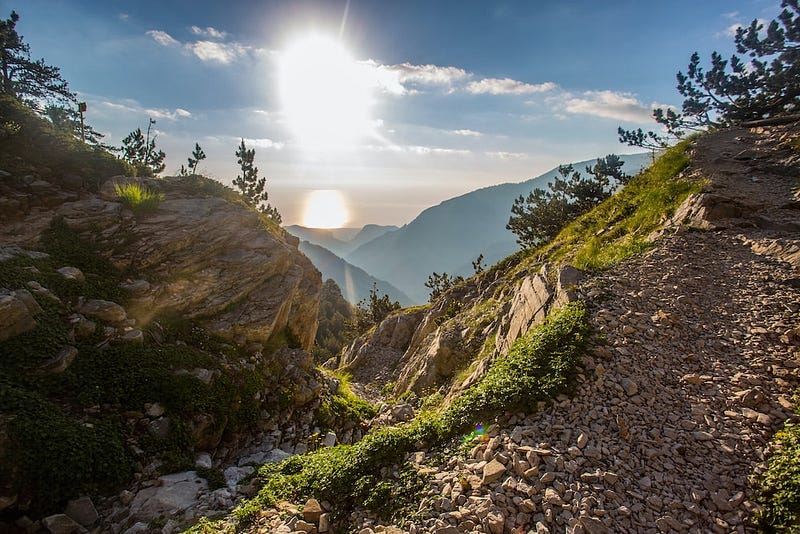
Tychon travels the last four days to Dodone on foot, making his way slowly up the hill and taking time to make a tent for himself and sleep in the intervening days. It’s not the hottest summer he’s ever lived through, but there are some three hours at the height of the day when it simply isn’t feasible to walk uncovered by the shade, and he’s carrying a good deal of water in three skins as he moves.
In winter, according to what one of the women in the last village had told him, one could follow a stream almost directly from there to Dodone, but for now it was dried up — it was smooth, at least, to walk on, and as good a path as he could hope for, with trees growing over it and offering some shade.
He’s grown up in a city all his life, and while he’s moved back and forth across the whole of Kriti, gathering herbs, meeting people, he’s never lived in a place so isolated as this, so high up in the mountains, so far from the sea.
His parents have both worked at the temple of Athena all his life, his mother a priestess, his father an olive tender on the temple staff and making the temple’s own olive oil — and serving a bustling, active city, they’re busy. He’s always been busy, too, making remedies and cures, serving as he could under different apothecaries and herbalists in the city and on the rest of the island.
There is a small shrine to Aristaeus in a central square, little more than a covered stone building with two columns at its entrance and a statuette within, and around it are a few scattered houses.
There is no nearby taverna or drinking house, no brothels, no gymnasia, no open stores, no tanners, no granaries, no storehouses, no noise. He can hear the cicadas, hear distant goats bleating, hear the breeze — he can’t hear men, he can’t hear workers shouting to each other or working women singing, or children in the streets.
He’d known it would be quieter — his father had said it would be.
But this emptiness, this desolation?
“Who are you?” asks an old widow, and he shifts his satchel on his shoulder, looking to her.
“My name is Tychon, son of Iphigenia of Knossos. I’m searching for Agathinos, the priest.”
“Oh, you’re the herbalist?” she asks, striding forward, and he stands obediently still as she reaches up to nudge up his chin to examine his neck and throat, and then to pull it down again so she can look at his face. “How old are you?”
“Twenty-four.”
“Young,” she says approvingly. “And strong. Have you any skill at carpentry?”
“No,” Tychon lies.
She frowns, pouting out her aged lips slightly. “Fine. Have you a balm for sore feet?”
“How sore?”
“Blisters — my son bought me shoes, and they don’t fit me well.”
“Don’t wear them,” Tychon advises. “In summer, anyway, there’s no need for anything but sandals. But yes, I can make a balm for you.”
“You don’t have one on you?”
“No, Ma’am, I’ve been travelling for some weeks.”
“On foot?”
“By cart, from Athens. On foot from Arta the past few days.”
“Hm,” she says, and then turns and points to a house much further up the hill, one that he can only see the roof of from here. “The priest lives there.”
“Is he home?” Tychon asks, but she’s already bustled off, and he sighs, continuing up the hill and trudging up to it.
The sun is shining brightly and it’s approaching the highest point in the sky, so at the very least, he should still be home soon for him to rest in the afternoon.
It’s not an extremely large house, but it’s bigger than many of those around the village, and Tychon nudges the door open with his shoulder, stepping inside and looking around. It’s nicely appointed inside — the tiles under his feet are pleasantly cool, and the house itself is under the shade of a tall pomegranate tree and several olive trees which keep the bulk of the sun away.
He unties his sandals and sets them aside, wiping his feet on the mat and hanging up his satchel before he makes his way further in. He’d seen there was a well in the village proper, near to the shrine, and he sees there’s a jug of water already drawn and set aside with a stopper.
Outside he’d seen the remnants of an open fire and spit, but here inside there’s a stone oven over the empty fireplace, clean of soot and wood at the moment and currently storing a few folded blankets; there’s a table with two chairs either side of it, and several more chairs are stacked on top of a cabinet. He sees several scrolls of parchment resting in an angled shelf, but the opposite wall is empty of any wall shelves or sconces. There’s a cabinet and a lower table against the wall, but the wall itself is a broad expanse of white plaster, a good canvas for him to work on if the priest allows it.
There are a few screens folded and resting in the corner — perhaps the priest just doesn’t use them, perhaps he uses them to keep a little extra heat in during winter, around the bed and fire.
The home of Agathinos strikes Tychon as very drab, actually, and somewhat sad. Apart from the one expanse of blank wall, the other three are also undecorated, with no art or charms or tapestries; the jugs and pots and plates he sees neatly set on one of the open shelves are all of plain clay make, with no patterns or images on them; there are no rugs or carpets beyond the plain woven mat he’d wiped his feet on, and the blankets folded aside are of undyed grey wool. The cloth sheet on the bed, stark white, is matched to the white plaster of the walls; the furniture is uniformly made of unpainted pine; the tile’s red-brown colour is as unremarkable as their design is sensible.
“What sort of man is he?” Tychon had asked when his father had told him where they planned to send him. “Is he witty? Does he dance or sing? Is he handsome?”
“He’s a good man,” his father had said. “Dutiful.”
“Does he play any instruments, or play games? Is he a poet, or a raconteur? What thought has he of art, or music, or philosophy?”
His father hadn’t seemed to know what to make of the question, and had leaned back in his seat, glancing to Tychon’s mother, who had been weaving. Without looking up from her frame, she’d said, “He’s a good priest, well-respected in Dodone and all the villages around, and he said he’d take you. Either we send you off to him to act as his wife, or you stay here and marry a woman.”
He’d dropped the subject.
Picking up one of the scrolls from the well of the shelf, he unfurls it and scans the text — not, as he was hoping for, a play or a piece of poetry, but a statement of accounts. Examining a few of the others shows much the same, and he rolls them neatly back up, setting them back in their place.
The cabinets are surprisingly sparse, many of them empty, much like the open shelves — he finds a few more sheets of cloth, some shoes and spare sandals, a hanging cloak, some stored coin, some chalk, a few wax tablets and styluses.
He’s never known a priest to own so little, to have so few possessions, and he wouldn’t be surprised if the house had been built for him — clearly, it’s too big for one man of such modest wants to live in, and Tychon wonders if the furniture filling it had mostly been gifted to him, or if he’d bought it simply because he felt he ought.
Tychon goes outside to look about the yard — there’s a herb garden growing under the shade of Agathinos’ olive trees: sage, thyme, rosemary, basil, fennel, oregano, and from a different outside door is access to a cellar, where wine, honey, wheat, and olives are stored in neat rows of barrels and containers, a few dried herbs hanging in bundles from the ceiling. The cellar has been very carefully made, with drains leading out from the floor and out, Tychon guesses, to the side of the hill so that it doesn’t flood in winter.
There are things with actual patterns on down here, stored in a few cupboards in neat, orderly piles — nice plates and jugs, a set of dishes painted with dolphins, several rugs and woven fabrics, a good deal of jewellery, finer clothes than what’s served upstairs.
This is more what he would expect of a priest, and here it is, down in the cellar.
Tychon asks after Agathinos from a pair of passing men as he fetches more water in the village — they shrug and say they don’t know where he is, that they don’t keep track of him. One of them asks if he’s the new herbalist, and when Tychon says he is, he asks — far more politely than the old widow had — if Tychon can make his wife an embrocation for her ankles, which are aching with her most recent pregnancy, and Tychon tells him yes.
Washing himself, especially his hands and face and feet, he goes back inside and tries to busy himself as he waits for the priest to return — he unpacks his mortar and pestle, the phials and dishes he’d brought with him, his physician’s tools, his needles; he hangs up his cloak; he eats the last of his own bread, now mostly stale but still edible, with some of the oil from Agathinos’ table.
After high noon has been and gone, he finally lies down, exhausted, and sleeps for several hours — when he wakes, the priest still isn’t there.
Some hours later, when the sun finally fades beneath the horizon and leaves the sky a dark and lusty red, he still isn’t there; hours later still, when the sky darkens to a rich, plummy black, and the stars are visible, Tychon is still alone in the priest’s house, and powerless, goes back to bed.
* * *
Tychon wakes in the morning to sun shining in through the windows, and Agathinos humming to himself as he combs his beard. He is looking with faint interest at the scrolls Tychon had brought with him — a few favourite verses from the Iliad, some poems, a few plays. He’d carried all the scrolls in one sack, just the paper, and had been careful — there are one or two small tears of the papyrus, but they’re all intact.
The priest is already dressed for the day, and Tychon looks to the side of the bed beside him, sees the impression on the sheets and on the other pillow. Curse his tendency to sleep heavily — curse, too, that he’d stayed up so long waiting for the fucker to come back.
“Ah, you’re awake,” he says. “Tisiphone said you’d make her a remedy for her blisters, that you hadn’t yet.”
“Tisiphone is the old widow?”
“Yes.”
“I made a balm for her last night with oil and lemon — I made another for Iris, Castor’s wife. Her ankles are swollen.”
“Very good.”
He’s older than Tychon expected, nearer to forty. His beard, dark brown with grey about the chin, is neatly trimmed and his hair is braided to keep it back from his face — he has dark green eyes and an absent-minded smile, and sunspots on his cheeks.
“I’ve milked the goats,” he says. “There’s cheese curds draining in the cellar — I’ll set them in brine once I’m home.”
What goats?
“I’m going now, over the river. Do you know the river to the north?”
“I thought the river had dried up for summer?”
“The streams have — the river still runs down from the lake, although it’s shallow at the moment. There are some toads, some fish, even. You can pick herbs there — Tisiphone will tell you.”
He’s already putting his satchel on over his shoulder and putting on a broad hat to protect his face from the sun, and Tychon stumbles getting up from bed, facing him naked. Agathinos seems mildly surprised and curious, looking at him askance.
“Yes?” he asks.
Yes, he asks.
Yes, as though a beautiful young man hasn’t travelled some hundreds of miles to be here, in his bed — yes, as though he hasn’t just forgone any introduction, any question, any conversation. He hasn’t asked Tychon how long his journey was, nor how he found it — he’s asked nothing of Tychon at all, or invited Tychon to ask him anything.
This isn’t how it’s supposed to be, Tychon is sure of that, and yet faced with the opportunity to say so, his tongue turns dumb.
“I want to bathe,” Tychon blurts out, and Agathinos peers at him. “Is the river deep enough for that?”
“Follow it upstream, to where the woods begin. There’s a pool there — it’s not too far to walk. An hour or two. We wash our clothes there as well as bathe.”
“Thank you,” says Tychon, and Agathinos turns to go, his hand on the doorlatch. Tychon asks as he pulls it open, “When will you be back?”
“Oh, later,” says Agathinos, waving one hand over his shoulder, and leaves without even turning to give Tychon one last look, let alone say any sort of farewell.
The door drops shut, and Tychon drops back onto the bed, groaning into his pillow.
* * *
After another hour of lying in bed, feeling miserable, Tychon rises, clothes himself, packs his leather case of ready-made cures, and has his satchel ready for him to pack with herbs he gathers at the river. There’s a good amount of string and yearn already in the house, although he makes a list on one of the tablets — he needs pieces of cloth, needs to purchase some more vials and flat dishes. Most people return them after they’ve gotten through whatever cure he’s given them, or provide their own in the first place, but he needs more.
He’d brought supplies with him of the hardest to get or most expensive supplies — seaweeds and corals, octopus and squid ink, powdered urchin shell from the coast; the imported bits and pieces he’d bought on trade ships from Egypt or Libya, or farther away still.
Most of the basics in his cabinet he’ll have to gather anew and dry — and he needs storage for all that, too.
Iris, moderately pregnant and sore but sanguine, thanks him for the cure and gives him a few oboli, and as he’s leaving the house Castor asks for his help in removing a thorn from his goat’s leg.
“I just need to hold her down for you to pull it out,” he explains as they approach, and Tychon leans forward, making a few kissing sounds with his tongue and examining her front leg, where the needle of thorn is sticking out. He reaches into his bag for a set of tweezers, and when the nanny shoves her head into his thigh, demanding attention, he scratches her ear.
He swipes out with one movement of the tweezers, pulling the thorn free before she can realise what he’s doing, and she lets out a surprised bleat of sound, raising her head, but doesn’t seem to realise what’s happened.
The wound doesn’t bleed, but he smears a little ointment on it anyway — this, she doesn’t appreciate, and she lets out a loud complaint before moving off and back into the midst of the other goats.
“Oh,” says Castor approvingly. “You’re good with them.”
“Call on me if you need me,” says Tychon mildly. “You know where I live.”
Castor hesitates, looking at him thoughtfully, and Tychon doesn’t walk away immediately, waiting patiently for him to ask his question, knowing the moment will come. He’s comfortable enough with silence, likes to use it, likes to let other people fill it, if they need — it doesn’t seem it’s a strategy he’ll be able to use with Agathinos if the man is constantly in motion.
“You don’t want to marry?” Castor asks.
He’s a passably attractive man, plain in the features, meaty, with broad hands, but this doesn’t strike Tychon as a precursor to a seduction, nor even an invitation for sex.
“I’m here for marriage,” says Tychon, “after a fashion.”
“But a real marriage,” Castor says, furrowing his brow, his head tilting to one side. “With a — You’ll have no children.”
“What would I do with children?” asks Tychon. “The meat takes ever so long to mature.” Castor does not understand his joke sufficiently even to be offended by it, just stares at Tychon uncomprehending, and Tychon adds, “I am not for women, nor women for me. My parents, understanding this, have arranged an alternative for me, for which I am grateful. Call on me if you need me.”
The nearest herbalist is some week or two’s travel away, on foot, Tisiphone tells him, and she’s an old coot who had designs on Tisiphone’s husband when they were young, which Tisiphone has evidently never forgiven her for despite the man having been dead for ten years, and not having spoken to the other woman in thirty.
She makes no commentary on the state of his marriage with their priest, nor comments as to or asks anything further about him or his life — she neither thanks him nor pays him for the cure, but she does chatter on about places where different herbs and flowers grow, and he makes a mental note of each and every one of them.
He walks around Dodone, makes his introductions, gives out small cures to those that need them and makes note of those who’ll need larger ones; he picks marigolds and poppies, wheat, fennel, heliotrope, ironwart.
After his sleep in the afternoon, he walks up the hill to bathe, walks back down, commences to tying everything in bundles to dry.
Agathinos doesn’t come back that night.
The following morning, Tychon takes down the cheese curds himself and puts them in brine.
* * *
Days pass, then weeks.
Agathinos comes and goes, only sleeping a few scant hours at home or bringing back honey or milk. After a week, Tychon meets the goats and two sheep, which are permitted to wander the surrounding area in the company of a dog called Kapnos; after two, Agathinos tells him where his bee hives are.
He makes offerings at the shrine to Aristaeus in the centre of the village, and he cares for other shrines and small temples in the vicinity, walks for days in each direction before he comes back.
Tychon is not accustomed to lying in bed alone in a large bed night after night, untouched. He is not accustomed to letting the hunger build up under his skin — he is accustomed to being touched and fucked as he pleases. He attends the gymnasium and the baths; he plays with the sailors; he has friends with whom he lies or bathes.
It’s the longest he’s gone without someone else’s hands on him since he was a boy — even were he not fucking, he’d at least be able to wrestle or seek out some form of physical affection, some touch, some love.
One week he spends every night staying up late to greet Agathinos — he sprawls naked in his bed, freshly bathed, wearing fragrant oils, night after night.
He doesn’t come home for two nights — on the third, he doesn’t even come inside, but sleeps out on the hard ground with his fucking goats, and Tychon wakes with his cock hard, his balls aching, to Agathinos saying cheerfully, “I baked fresh bread and brought you a parcel of mastic, they’re on the table for you!”
The door is closed behind him, his supposed husband departed, before Tychon can say a word.
“Fuck it,” he mutters, and pulls himself out of bed.
He had been careful to keep most of his work contained to one area of the house, but given that Agathinos evidently doesn’t use the place except to sleep two nights of seven in his bed and store his honey and cheese here, he sees no reason to continue with it.
Agathinos is gone for six days this time — Tychon fills the ceiling beams with nails to hang his herbs from, and goes through the fine things in the cellar and swaps out the plain things upstairs for them. He puts down a rug; he sets out the handsome dishes with dolphins on.
It’s an extremely hot week, and Tychon is in poor mood. The home is nicer now that he’s brought some colour into it from downstairs, but the large plain wall still bothers him, so he moves one of the cabinets and begins to make adjustments.
Tychon is no great artist — his mother taught him to weave, and he never had the concentration for it; his father taught him to paint, and he could never learn his father’s accuracy of dimension and proportion. His maps, though, are good — he’d been making notes on scraps of papyrus and on a few spare tablets, and now he simply begins the process of transferring them to the wall.
Dodone is in the centre, the shrine to Aristaeus, the houses about it, and then he paints the further area — the olive groves to the north, the lake, the villages further out. In between, he marks where other plants grow in larger amounts — hypericum, chamomile, sage, wild carrots, valerian.
Lying on the tiled floor between going out and feeding Kapnos and his flock, cooking small amounts over the fire, it gives him some small relief from the sun outside.
He feels like a prisoner, alone and isolated, and he wants to go home.
* * *
After a final cooler day, he wakes in the middle of the night and sleepily gets to his feet to see Agathinos home and stripped of his clothes, standing barefoot with a candle in his hands to look at Tychon’s work on the wall.
There are drying flowers and leaves filling the room, some hundred bundles of them hanging from the beams above their head, a great many jars and dishes covering the table and the dresser’s top surfaces, bottles of oil, water, wine, concentrated spirits filling the shelves that had been empty.
Agathinos turns to look at him.
“Does it bother you?” Tychon asks — demands. He sounds sleepy, but there’s a sharpness to his voice that elevates it somewhat.
He should be bothered. Here Tychon is, an upstart in his house, his home — Tychon is fifteen years his junior, sent to be his wife, his assistant, and this is what he’s done. He’s made a mess! He’s painted on the walls! He’s changed this shepherd’s shack into a home without the shepherd’s approval or his permission, and now here he is, examining it as though it’s never been his house at all.
“No,” says Agathinos. “I’ll tell the housekeeper not to touch any of your things — she comes once a week.”
“Only twice a month, in the summer months,” Tychon corrects him. “And her father is dying, she won’t be back until the autumn. I paid her for the intervening months and gave her an analgesic for him.”
“Oh,” says Agathinos, and then nods his head. “Very well.”
Tychon’s hand twitches at his side, and he wonders what the old goat would do if he slapped him.
“Are you coming to bed?” This comes out as less of a demand and more of a whine, wanting and mildly desperate — he’s so hot he feels his skin might well steam at the touch of somebody else’s, but Agathinos’ wiry, muscular body looks impossibly good in the dim light from the bee’s wax candle, his arms strong, and he has a good-sized cock even soft.
“Soon,” says the priest. “Go back to sleep.”
Tychon wants to demand it of him, wants to request it, wants to beg, and yet he opens his mouth and the words just don’t come, won’t come, frozen on his tongue and in his throat. He can’t even make himself look attractive, can barely remember how to present himself in a way that’s desirable, how to tip back his head or open his body language, how to invite a man silently to bed when that man is already looking away from him, gone back to examining the map Tychon had made.
“What is this?” he asks, pointing. “This brown, there are marigolds here?”
“Onions,” says Tychon.
“You use these in medicine?”
“… I eat them.”
“Oh,” says Agathinos, and laughs softly. “Of course.”
He makes no motion in Tychon’s direction. Exhausted and unfulfilled, Tychon falls back into bed.
* * *
Bar some of the older people, who don’t seem to care much about it and have no interest in learning more, the people of Dodone and the surrounding villages are friendly enough. After a month of his being here, people begin to approach him when they see him out gathering herbs or tapping trees for their resin, and some travel from the surrounding villages to see him.
“How are you finding it?” they ask him. “Do you like the village?”
Of course, what is he to say?
No, I fucking hate it? No, I hate this isolated backwater, where there are no gyms, no parties, no life? No, I haven’t been fucked for six weeks, and I think I might well die of it? Do any of you have the trick, by any chance, as to getting your beloved chosen of Aristaeus to make a happy Ganymede of you?
“Are you warm enough as the nights get colder?”
In what universe are the nights getting fucking colder?
“Are you finding all the herbs you need? Do you need more tools?”
These people have no close-by herbalist — what the fuck would they know of herbs?
He is aware he is being unfair. He is aware that the people of the region are kind and tremendously patient, in large part because they are so far away from the conveniences of the city and unlike Tychon have simply learned to live without. They are complimentary, pleasant, and generally very thankful — they pay him although he offers his first cures for free, and offer him trade in kind, notice the things he uses and the things he carries, offer to make or give him more without his asking.
“What do you think of your priest?” he asks bluntly of one of the villagers — Ariadne — as he applies a paste to the rash on her shoulders, and she turns back to blink at him.
“Agathinos? He serves us well, he leads us well at festivals. His goats produce good milk, and his bees produce good honey.”
“And his personality?”
“Oh,” she says, furrowing her brow, and then laughs. “I don’t know that I’ve ever noticed one.” She hesitates, then, and says, “You were brought here to live alongside him.”
“To wed him, after a fashion.”
“I’d heard that,” she says. She doesn’t sound convinced.
He doesn’t know what that means, exactly, what her hesitation implies, and he asks, “Why did he want me, then?”
“You’re a good herbalist, aren’t you?” she asks. “We had need of one.”
It frustrates him, for some reason, eats and digs under his skin as he goes about his day.
* * *
The weeks tick by and by, and as the summer comes to a close and the autumn rolls in, Agathinos comes home more often, and sleeps longer at night — sometimes, Tychon even rolls over and sees him there in bed beside him, although it’s always on nights when he’s exhausted from walking all day.
This proximity doesn’t lead to Tychon getting fucked, even though he comes to bed nude despite the cool, and poses naked about the house, beside the fire, while he works.
He wanks beside him, even, makes a picture of himself as he curls his hand slowly about the length of his cock and fists himself slowly, luxuriously, up and down. He moans breathlessly into the side of his arm as he twists his wrist, his hips jumping forward as he grinds against his own palm.
Some nights he fucks himself with his fingers, chokes on his breaths as he sinks himself down on them, rides them, whimpers and gasps as he comes in hot, wet ropes over his hand, his wrist, until he’s laid there breathing heavily with the exertion, the aftermath of his orgasm weighing him down.
Agathinos doesn’t so much as look at him.
* * *
A caravan comes through on their way further south, to Athens, and Tychon meets some of them up at the lake. He exchanges remedies with some of their labours, trades for herbs they’ve brought from further north.
It’s been some time since he’s spoken to a Macedonian, and he laughs and chatters with several of them, discusses different herbal remedies, different applications. It’s getting dark as he sits beside the fire with them — they talk about plays, argue about comedies versus tragedies (Tychon’s never seen the point in the latter, has always felt they drone on and on, but the Macedonians are a serious lot), talk about sports and tournaments.
Sitting at their fire, one of them has been looking at Tychon all night — he’s blond and steely-eyed, strong-jawed, and he looks at Tychon the way that Tychon likes to be looked at. He must only be Tychon’s age, perhaps a little younger, and where they sit together their knees keep touching, the sides of their thighs.
Tychon tips back his head and looks at him prettily, and after Tychon lets the silence rest between them for a few moments, the Macedonian kisses him.
Fuck, but he’s clumsy, unpractised, and yet it’s the best kiss he’s ever had, his mouth tasting faintly of honeyed drink. It’s the first time he’s been touched in months and his body thrills at the relief, the surging heat it lights deep within him, the lips on his lips, the hands touching his thighs —
And then his partner is wrenched away.
An older man whispers urgently in his ear.
The young Macedonian pales a shade or two, mumbles an excuse, and hurries off to his tent, disappearing within it.
When Tychon rises from his seat, he sees Agathinos standing at the edge of camp, a few of the Macedonians with him. His face is lit from below by the fire, and his eyes are dark and shining.
They walk hoe together in silence, Agathinos alongside him. He’s shorter than Tychon is, but somewhat stouter — his body is squarer than Tychon’s is, strong with lean muscle rather than soft to the touch.
“Well?” presses Tychon.
“Well,” Agathinos repeats. His voice sounds smooth and easy, unbothered.
“Are you ever going to fuck me?” Tychon demands, and Agathinos looks at him sideways, his expression unchanging.
“I beg your pardon?”
“I’m here as your wife, am I not?” he asks. “Why won’t you fuck me?”
“You haven’t asked me to.”
“I’m asking you now.”
“I haven’t heard you yet.”
Tychon’s cheeks are burning as he looks at Agathinos, and suddenly he feels small and young and tender in an unexpected way, a way that makes him thrill — he doesn’t know that he’s felt this way since he was a student and fumbling with older boys and young men.
“I’m waiting,” says Agathinos softly. His voice has a sharp edge to it, and Tychon can see the glint of his eyes in the scant light, see the slight curve of his lip.
Tychon’s breath catches in his throat.
“Very well,” says Agathinos, and walks on.
* * *
Tychon isn’t used to talking about it. It’s not as though he’s ineloquent or frightened to discuss sex or eroticism — merely that he doesn’t ordinarily need to ask for these things, doesn’t usually need to say anything. In the big city baths, there’s often an unspoken connection, an ease of operations between him and other men. He can just lean back in the right way, let his legs fall apart, let other men come to him.
If not that, he can go up to them, approach them, and there’s no need for words — he can invite someone with the right touch, with the right gaze, even.
Just like last night, with the young Macedonian — all he needs to do is pose himself in the right way, his body a silent invitation.
Agathinos is —
Hard.
How can Tychon ever invite him, if he avoids him so astutely?
The next morning, Tychon is groggily awake just as Agathinos is fixing up his hair, and he sits bolt upright and scrambles from his bedclothes in the cool dawn of the morning.
“Wait,” he says as he scrambles into his tunic. “I’m coming with you.”
“I’m tending the animals and some crop.”
“I want to know where they are, and what you do.”
Agathinos looks at him and smiles faintly. It’s not a particularly warm smile, but having not seen him smile so entirely before, it makes something flutter in Tychon’s chest.
“Very well,” he says. “Tie your sandals well.”
Agathinos leads the way up into the hills, through the closest groves of olives until they come up to a half-contained plateau — there’s fencing around it but the gates are open, letting the goats wander in and out as they please. There’s another pomegranate tree up here, although they’re not as ripe as the ones near the house, and there are fig trees and a few grape vines.
Agathinos opens up the door of a shed where the flock and the dog must sleep at night, pulling out a stool and a wide-brimmed jug and whistling sharply so that the nannies make their way over.
There must be a mile or two between here and the house — whenever Agathinos goes away for some time, the goats normally come to the house and invite Tychon to milk them there. He hadn’t even realised this was here.
Tychon grabs a crate and turns it upside down as a seat, grasping at another jug and clicking his tongue.
The nanny who makes her way over looks at him suspiciously, as if she doesn’t much want him knowing where they live, but Tychon just pats his knee while outstretching his hand to her. After nibbling his fingers and testing his palm, she walks forward and stands over the jug, lets him milk her as she has before.
Between the two of them, they make short work of it — the goats and sheep and Kapnos all look at Tychon with great interest, peering at him with their strange eyes, sniffing at him, nibbling at his hands, his arms.
Kapnos leans into his side as Agathinos pours the jugs into a jar with a lid and a leather strap about it, which he bands over his chest to carry with them. “Have you tended bees before?” he asks.
“No,” says Tychon, standing to his feet and patting Kapnos’ side before falling into step with him. “I’ve seen the hives, I know where they are. How do you keep them? You find out where they are, befriend them?”
“At first,” Agathinos says as they descend the hill. “I tend their favourite flowers, and when a hive of bees grows too big for their living space, they become docile. They swarm, and you can scoop them up with your hands — so long as you cup the queen and take her with you, the rest of the bees will follow. So I built hives, and I waited, and when I found a swarm, I took the queen and showed her a hive, and she stayed. That was many years ago, now. The bees I keep are long-descended from the first queen I brought home with me.”
Tychon watches in fascination as the other man works, using smoke to make the bees sleepy as he pulls out frames of wood full of their wax — he’s harvesting nothing for now, only checking them for illness and parasites.
He handles them with ease, as any priest of Aristaeus ought, and Tychon stares at the bees that linger on his bare arms, on his clothes, on the cloth veil he wears to keep them out of his hair and his beard.
“You will have honey enough as you require it for your remedies,” says Agathinos, ”but I’ll not do another harvest until the winter is through. They need the honey to sustain themselves as the weather gets colder.”
“They don’t sleep through the winter?”
“Not these bees, no. The wild ones, maybe. We shall see how much you need the honey over the winter — much of what I make goes to other shrines and temples in the vicinity, the excess from what I use myself. You will take what you need first.”
He doesn’t say it as if it’s a gift or a favour: it is a statement of fact, a state of affairs. If this were a real marriage, like the sort between a man and a woman, perhaps it would have been written in their contract before its culmination.
“Yes,” agrees Tychon, and then, in the coolest voice he can muster, adds, “Very well.”
Agathinos freezes bent over his hive, then turns his head to look back at him, his expression sly, and then smirking, before he returns to work.
They go to the temple, and Tychon watches him make his offers at the shrine in the small stone temple — there’s barely enough room for the both of them inside, and then another room for storing some offerings.
Agathinos leads them further out from the village and they eat together at a farmhouse, hosted by the farmers before Agathinos comes to examine their horse, and then their sheep, ensuring they are healthy for winter. One of them pulls Tychon away from where he is observing, and Tychon tends a sprained wrist, and then allots out some prescriptions for frequent headaches, and another for morning sickness.
They keep walking afterwards.
Tychon’s map doesn’t come out this way just yet, to the east — they go further out along the road, and they go to the next village and do much the same thing; they go to a third village; they go to a fourth.
Agathinos doesn’t introduce Tychon to anybody, just walks with him, and when Agathinos says he needs things — hot water, blankets, anything else — Tychon gets it and brings it over, acts as a second pair of hands; he prepares a balm for a cut on one goat’s shoulder; he sets someone’s arm in a sling after setting their shoulder back into place.
Agathinos doesn’t need to introduce him — they know who he is already.
It’s curious, accompanying him, because no one seems surprised at how unemotive or silent their priest is. Agathinos is a naturally laconic man, says little, and this doesn’t change just because Tychon is with him. They ask him questions — he answers them with the fewest words possible, or says nothing and simply goes to work, if he can.
It’s dark when Agathinos says, “Home now.”
“You do this every day?”
“In one direction or another. There are about thirty or forty villages and towns, plus whoever calls for me from further or closer.”
Tychon isn’t used to the journey, and they take a break on a stone bench beneath an apple tree, Tychon taking time to school his breathing as they sit together with his head tipped into Agathinos’ shoulder.
“Sorry,” he mumbles, rubbing at one of his eyes. “I normally sleep in the afternoon.”
“It’s alright,” says Agathinos. He’s warm and he smells of dust and goats and honey and sweat, and Tychon is used to it — he likes it. He’s used to it by now.
Tychon wakes in Agathinos’ arm, being carried up the hill like one of his goats.
“Oh,” he groans, shifting his cheek into Agathinos’ shoulder — he’s a grown man, not a boy, and he ought be humiliated, he’s sure, but it’s late and it’s dark and everyone is asleep, and Agathinos doesn’t seem to struggle whatsoever with Tychon’s weight, which makes his cock hard. He closes his eyes again, curls in tighter, and when they get into the house Agathinos carries him over the threshold and inside, into bed.
He has a burst of energy, what with this small nap taken into account — his legs and his body both ache, but he still tips them both over, straddling Agathinos as soon as he’s finished untying his sandals.
In the dim light, he sees Agathinos’ expression, the blankness of his face and the set of his lips, as he undoes Tychon’s sandals now, unlaces them and drops them on the floor with his own. Still silent, he pulls loose the tie at Tychon’s shoulder, loosening his tunic, and then pulls free the brooch at his own so that his rope falls down.
“Agathino,” says Tychon quietly, resting his wrists against his shoulders, his fingers curling around the back of his neck. “Agapi mou. Agathi mou.”
“Not funny,” says Agathinos, wrinkling his nose, and Tychon laughs.
Something changes in Agathinos’ face, his lips parting, his expression arrested, like he’s abruptly breathless.
“Are you going to fuck me now?” asks Tychon.
He can see the retort beginning to grow on Agathinos’ lips, can see him readying himself to make his rhetorical retort, but Tychon stops him before he can by crushing their lips together.
Agathinos’ gasp is so soft as to be almost inaudible, but Tychon cherishes the sound, seeks to cup it between his palms and take it with him wherever he goes, hesitant and sweet as it is; he grinds down against Agathinos’ hips, and Agathinos’ answering grunt makes his body hot.
His husband’s hands pull the tunic apart and toss it onto the floor, and then his hands are greedy in their movement over Tychon’s body — they touch his hips, digging into the flesh on his thighs and the plumpness of his belly, gripping at the generous weight of his arse. Tychon leans in and mouths down the side of the older man’s cheek, inhaling the scent of him that sticks in his beard and his hair before he tilts his head and grazes his teeth over the side of his neck.
His cock is so hard it aches, and that’s before Agathinos moans low in his throat.
“Are you going to fuck me now?” he asks in a warmer, sweeter voice, letting it lilt as he rocks his hips down against Agathinos’. “Don’t you want to feel me, see how tight I am, open me up for your prick? Don’t you want to make use of what’s been allotted you?”
“Is that how you think of yourself?” asks Agathinos, a deep tension coming into his voice, which comes from low in his throat, his chest. “An item I’m allotted? Your sex a service I’m owed?”
The sudden anger takes hold of him like a spark, setting him aflame. “Your sex,” Tychon growls, “is a service I’m owed.”
Agathinos’ breath hitches, his eyes widening, and Tychos grabs his hands from his hips and shoves him backward, pinning them above his head and staring down at him. Agathinos lets out a breathless noise, his robe bundled between them and probably getting wet from both of their cocks as well as his sweat.
“Is that why you’ve denied me all these months?” he demands. “Out of some concern for my honour? Some faux-respect? You bring me here across the fucking Aegean to be your wife, and you were never going to fucking fuck me?”
“You didn’t ask — ”
“I’m the son of a priestess with far more responsibilities than you, more fame than you, a greater name than yours. I am not accustomed to asking — I am accustomed to being given what I desire.” His voice is low and cool, a growl he makes no effort to pull back as he grinds their hips together, and he’s aware of the flush in his own cheeks, the heat pooling between his legs.
It’s even true, he thinks.
He isn’t accustomed to asking — he’s accustomed to being given what he desires before he even thinks of it, before he even asks, to exist prettily and to be worshiped, an extension of devotion at temple services.
The thought is distantly blasphemous in a way that makes him thrill, and he fears for a moment the idea that Agathinos should read his mind, should know what he’s thinking.
“Will I fuck you?” he asks, his voice gravel-rough.
“Very well,” says Tychon dryly, and Agathinos captures him in a biting, harsh kiss from beneath him. Tychon shudders atop him, lets his body go loose and easy, and when Agathinos rolls them over to shove Tychon on his belly, Tychon wails so loudly into the pillows he expects they can hear it down the mountainside.
* * *
When morning breaks, Tychon is sprawled in bed beneath the blankets, and he groans when part of his mattress makes to extricate himself — he wraps his limbs tighter about Agathinos’ body, pinning him as best he can.
“I must rise,” he says, “and tend our animals.”
Our.
Tychon’s kiss-bruised lips tingle with the remembered ghost of his husband’s.
“You’ve already risen, it seems to me,” says Tychon, reaching between his legs and taking him in hand, huffing out a soft laugh at the grunt it draws from his throat. “Stay in bed a while.”
“… Very well,” is the reply.
FIN.
Leave a Reply