A distinctly queer adventure full of internal conflict ensues when a gentleman and a sailor are captured by pirates.
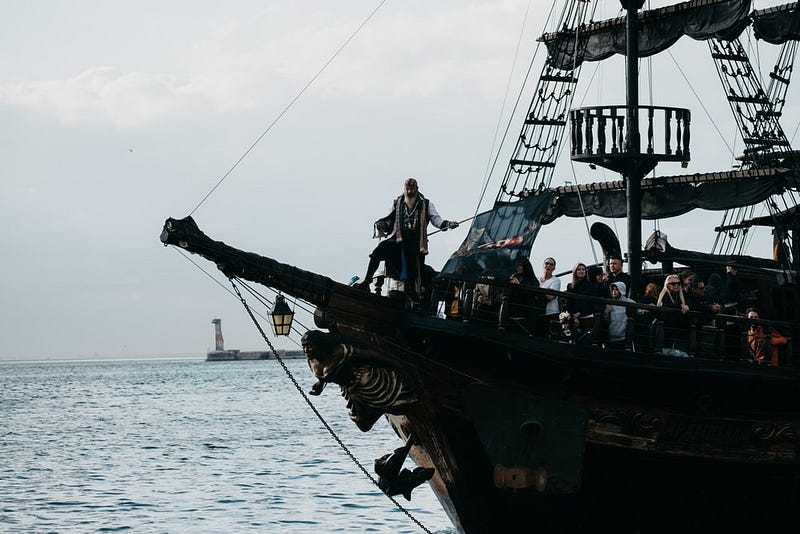
A little bit of adventure, romance, and queerness in the 18th century Mediterranean!
An adaptation of my TweetFic, Gerald Poole & the Pirates. This is going to be posted in several parts, with this one being 14.2k in length.
Part I | Part II | Part III | Part IV
Content warnings: consent issues throughout and sexual threats, violence, period-typical racism and homophobia, self-esteem and identity issues.
“… and this is Second Lieutenant John William Wicks,” said Captain Lewisham.
The captain himself was a tall man, grizzled in the way some men old beyond their years were, with hollows showing on his thickly stubbled cheeks and dark shadows underneath his eyes. His lips were darker in colour than his skin, which was naturally pale but made uncomfortably red by the sun, and he didn’t look after them, it was plain to see, because they were chapped and Gerald could see a bitten mark on his lower lip.
He couldn’t have been older than forty-five, but he might have passed for sixty.
Wicks couldn’t have been more different.
He was the same height as Lewisham, the both of them six feet tall, but where Lewisham was thin and underfed and wiry in the way of a fox that strayed into the city, Wicks was packed with brawn and fat. His great chest was barrel-shaped, his shoulders broad, his thighs and his upper arms heavy and tough as ham hocks, and his perfectly pressed and starched uniform strained at the seams in the most wonderful of ways.
His face, Gerald was pleased to note, was quite handsome as well — he had a large head to accompany his large body, and it was a very nice head, Gerald thought, one of the finest he had seen in some time. Wicks had a strong jaw and a cleft chin, handsome, dark brown skin, thick, black hair pomaded into submission, a broad, square nose made of supremely sensible angles, and plump lips almost entirely lacking in definition, making them seem all the more kissable.
Unfortunately, Lieutenant Wicks did not give the impression of a man who wanted to be kissed — in fact, he was looking down at Gerald so coldly that he couldn’t help but feel another k-word was closer to the surface of his mind.
“Hullo,” said Gerald, with forced brightness. “What a beautifully starched uniform, Lieutenant.”
“You were expecting a sailor in improper dress, sir?” asked Wicks without hesitation.
Gerald faltered at the briskness in his tone, and looked askance to Lewisham, whose chapped lips shifted into a small, unpleasant smile.
“Wicks will look after you in your time here, Mr Poole,” said Lewisham. Gerald was distinctly aware of the double meanings present in a phrase like to look after. “Have you sailed before?”
“No, Captain Lewisham, I never have,” said Gerald uncertainly. “But I’m sure I’ll, ah, rally to meet the challenge.”
“Well, Wicks’ mother was in service,” said Lewisham, with a sort of sneer to his voice that Gerald didn’t much like the sound of, and he didn’t like the way it made Wicks’ face tighten either, the press together of his plump lips. “I’m sure he’ll be able to perform the duties you need of them.”
“Oh,” said Gerald. “Oh, Captain, I hardly need, ah, a valet — ”
“For your safety, Mr Poole,” said Lewisham. “I wouldn’t put a young man like you, used to such…” Lewisham cleared his throat. “Comfortable environs among my men without a buffer. Wicks is that buffer.”
Gerald didn’t know what to say to that, but behind them, everyone was going down gangplanks and whatever else, and it seemed it was time to go aboard. The gangplank, as he walked down it, moved, the ship swaying and making the whole of the strangely slatted board move and shift under his feet.
He froze in the middle of the plank, trembling so hard he couldn’t bear to so much as move his feet, but too frightened to go back. He was terrified of falling into the water — he could swim, but he didn’t like the look of the deep port waters, with ships and chains and ropes all over.
Wicks came up behind him, and although his weight — he must be heavy, Gerald thought, with all that muscle, muscle was heavy, wasn’t it? — didn’t make the plank go entirely still, it did stabilise it somewhat.
“Move,” said Wicks, and when Gerald kept shaking, Wicks pushed him in the lower back.
Gerald whimpered, but he didn’t fall as he stumbled hurriedly forward, Wicks stepping slowly behind him up the plank, and Gerald for a moment was relieved when he fell in a pile of limbs onto the deck. He swiftly realised he was wrong about this. It wasn’t quite so bad as the plank itself, because he wasn’t about to be tipped into the water, but sitting on his arse on the wooden boards he could feel the whole ship moving underneath him, and it made him feel sick to his very stomach, to his very core, and the nausea roiled within him.
He had travelled long periods by coach before, and sometimes he did feel a little unwell on very rough journeys, but it wasn’t anything like this.
“You look pale,” said Wicks as he dragged Gerald up to his feet with a hand under his elbow, and on his feet, the nausea did not immediately go away. His knees felt weak, his whole body felt weak, and he opened his mouth, but didn’t manage to talk right away.
He gagged without meaning to, and Wicks propelled him abruptly to the rail so that when he vomited, it went over the side. Wicks had him lifted almost by the hips, so that the spatter didn’t actually hit the side of the hull, but dropped into the water.
As Gerald watched, coughing, a few fish bobbed to the surface and started going through the mess.
“I’m so sorry,” Gerald said miserably. “I’ve never been on a boat before, Lieutenant.”
“You still haven’t,” said Wicks, tone dark as he offered Gerald a handkerchief to wipe his mouth with, and Gerald did so obediently. “This is a ship. Come, they’ve had quarters put aside for you.”
“How long will it take for me to stop feeling ill?” asked Gerald.
Wicks released a derisive noise.
It was not a comforting answer.
* * *
He had very much wanted to enjoy sailing. It struck him as delightfully and incredibly exciting, to be swashbuckling upon the roiling seas, working hard under the heat from the sun, singing along with chants, and whatnot.
There was less romance in the matter when one spent a lot of one’s time lying on one’s side in the cupboard that had been set aside as one’s quarters, feeling constantly sick and dizzy.
After a week or so at sea, he was able to becalm himself when the seas themselves were particularly calm and they weren’t moving too quickly over the waters, and he managed to read a little of his books, walk back and forth a little.
Whenever he tried to leave his little cabin for something other than mealtimes, though, Wicks would appear at his shoulder, would materialise as if from the air itself — for being such a big man, he had an extremely light step, and he moved as quickly as a shadow, when it suited him.
When it suited him, it seemed, was whenever it seemed as though Gerald might look as though he were about to go above decks, or when he tried to have a look at what any of the sailors were doing, but they all did such interesting things. Everyone was always working at something, fixing rope, repairing sails, oiling things or waxing things or nailing things together or doing joinery or whatever else, and in the mess sailors were often sleeping in their hammocks or on thin bedrolls laid out at the edge of the cramped room, or eating or drinking, or playing cards, or even reading books, which surprised him, because Gerald hadn’t realised so many sailors could read.
He didn’t know that all of them did, no, because some sailors would be reading aloud to others or crowding around the same little pile of pages, but more of them than he had expected could read.
Gerald had almost thought only the officers would.
Wicks didn’t like it when Gerald bothered the sailors, interrupting their leisure time or speaking to them while they were working. He didn’t like it when Gerald went above decks. In truth, Gerald wasn’t sure he liked it when he left his cabin — and for that matter, it struck him that Wicks might prefer it were he asleep the whole time.
Just a few minutes ago, Gerald had seen one of the particularly handsome sailors with a black eye blooming over his eye, and as soon as he’d gone to ask him about it, Wicks had burst from the ether to usher him back to his cabin and get him dressed.
“I am sorry,” said Gerald as Wicks helped him into his dinner jacket. He’d been eating with the officers every evening, a guest of honour as they shipped him eastward, no matter that he didn’t think they actually liked him very much — Lewisham certainly didn’t seem to particularly care for him, and nor did his quartermaster, a man named Boggs. They were polite, never said anything untoward, but sometimes when Gerald began to chatter about something, asked questions, he’d be met with such gripping silence that it cut him to the very core.
He so hated to be met with silence, no matter what it was he’d said.
“Sorry, sir?” asked Wicks.
“That you have to keep bothering yourself with me, I mean,” said Gerald. “I’m sure there are, ah, far more important ways you might be spending your time.”
Wicks didn’t reply.
He employed silence rather a lot.
It wasn’t as though Gerald made himself, he didn’t think, painfully obvious or unkind or unpleasant. He was just overwhelming, he knew, and too loud, and rather too much, as he always had been. He’d been trying to withhold himself, at least in Wicks’ presence, but it made no difference, as it never did.
It was several more weeks later that Gerald was shaken awake in the dead of night with Wicks leaning over him, dragging him out of his bedclothes. It was a surprise, but no less flattering, and he laughed softly as he pulled himself to sit up in the dim light.
Wicks was unsmiling as ever, his face lit strangely by the candlelight.
“Put this on,” he growled.
“If that does it for you,” said Gerald, feeling his cheeks burn with a pink blush, and let Wicks dress him in what appeared to be a uniform. The shirt was a little too big for him, but the jacket fit him perfectly, and Gerald couldn’t help but wonder who he’d pilfered it from, because barely any of the sailors he’d seen were as petite and slim as he was, but for some of the midshipmen —
The door slammed as it was thrown open, and Gerald froze, his fingers unbuttoning Wicks’ jacket as Wicks’ buttoned up his.
It wasn’t a face Gerald was familiar with, and Gerald looked from his face to his clothes, his open shirt and greying chest hair, his unkempt beard, his dark red trousers. Where his head of hair was black as anything on the top, his sideburns and beard were turning quick to salt and pepper, and he wore a gold hoop through one of his ears, wore a few rings, too, and tattoos covered his arms and shoulders.
He was holding a blade in his hand, its polished edge glinting in the light.
He didn’t look like any sailor Gerald had seen, these past weeks, and Gerald’s blood went rather abruptly cold.
The pirate in the doorway laughed at the both of them. “Get on the top deck, lads,” he said. “Now’s hardly the time for that.”
Wicks kept Gerald close to him as they went above decks, and murmured, “Don’t say a word.”
“But — ”
“Not a word,” Wicks ordered crisply, and Gerald let his jaw click shut as they went onto the top deck. Many of the sailors were sitting in rows, cross-legged or kneeling with their heads bowed, and Gerald looked to the other ship bound close to theirs, a great many lines strung between the two of them.
Pirates were walking between the rows of people, big swords in their hands, and Gerald saw many of them held pistols too. Wicks pushed Gerald down to sit directly in front of him, and when Gerald craned his head to get a glimpse of Lewisham and who he assumed was the pirate captain, a man in a purple jacket, Wicks grabbed him by the back of his head and shoved it forward so he’d look at the floor.
Lewisham was bleeding, slouched in a chair and leaning to one side, and the ship’s surgeon was holding a wet cloth to the side of his head, and as Gerald looked out of the corner of his eye, fighting the desperate desire to lift his head and see properly, the pirate captain came forward.
“Hardly any reason to panic,” he was advising. He was quite possibly one of the most beautiful men that Gerald had ever seen, and Gerald was arrested at the mere sight of him, his lips parted, his eyes wide.
Under the beating Mediterranean sun, the pirate captain’s bronze-brown skin shone almost gold, and his brown eyes glittered like so much molten honey; his hair, which was black and tremendously fine, shimmered in the light as though the tresses themselves were woven from water, and at the places where his clothes showed the skin underneath — where his calves showed, his forearms, where his chest and neck were bared by the plunge of his loose-worn blouse — he was covered over and around with scars and tattoos. Rather like Lewisham, he wore a few rings on his fingers, but where Lewisham’s rings had a sort of plain and tired quality to them, worn for his station, the pirate captain’s fingers glittered with jewels and different colours in the bands of shined metal.
“We don’t want to do any of you any harm,” he said smoothly to the men all on their knees, moving with a cat-like grace upon the ship’s boards and moving with the sway of the deck beneath him, as though the swell of the water was as natural to him as the rhythm of his own breaths, “except, of course, to your coffers.” He laughed, and it was a merry, beautiful sound — he spoke with an Englishman’s cadence, and Gerald was not tremendous with accents, but he struck Gerald as a merchant’s son, perhaps. He was educated, but he lacked the stuffiness Gerald knew rang out in his own voice and that of his brothers — he had gone to school, but not the likes of Eton, or any school like that.
The grizzled sailor in the red trousers who’d met them downstairs moved forward, and the captain turned to greet him. The captain was taller even than Wicks, tall and graceful in the way a statue was, so much so that it sometimes seemed a surprise that he moved so easily; the red-trousered fellow was shorter, more like Gerald’s own height, and the captain had to lean so that he could murmur in his ear.
Gerald leaned forward, craning his ears as if he might hear some word as the captain and his lieutenant both looked in their direction, but Wicks grabbed him by the back of his neck and shoved his head again down that he face the ship’s deck.
He heard them laugh.
It was out of the corner of his eye that he saw the red-trousered man hold up a leatherbound book — the captain’s diary — to his captain, and Gerald watched the pirate’s expression change subtly. His beautifully sculpted lips pouted slightly, and his eyes, which were heavily lidded and had thick, dark lashes, narrowed.
“Now, Captain… Lewisham, is it?” he asked, turning back to the captain slumped in his chair. “It seems we’ve been dishonest with each other. I so hate to begin a relationship on such poor terms.”
Wicks’ grip tightened on the back of Gerald’s neck, balling up the back of his shirt, as the pirate captain stepped slowly closer to Lewisham.
“Point him out to us, won’t you?” asked the pirate captain sweetly. “We’ll hardly harm a hair on his head.”
For a moment, Gerald thought that Lewisham was holding his tongue intentionally, but he was slumped very badly in his seat, and Gerald watched the pirate captain reach out, pulling his head up slightly by the hair. He frowned at Lewisham as the surgeon said, “Wait, wait, he’s — “
“Concussed, yes, I see,” said the captain distastefully. “Mr Cotton, would you?”
Gerald winced at the deafening bang when the pistol shot rang out, and Wicks dragged Gerald closer to him, shifting so that Wicks was between Gerald and the pirates on the main deck, and Gerald couldn’t help the way his hands were trembling.
Captain Lewisham’s body was thrown to one side, and the pirate captain and his mate, Cotton, began to make conversation with the quartermaster Boggs instead.
“We only want to ransom him,” the pirate captain was saying. “Don’t make us conduct a census of your crew, dear man — if you force us to do so, you will find it is writ in blood.”
“I must step up,” he whispered to Wicks, who shushed him. “But, Lieutenant, he just said, they’ll kill another — “
Wicks elbowed him so hard in the stomach that he wheezed, unable to speak, and put his finger most demonstratively to his lips. Gerald set his jaw as he tried to catch his breath.
The captain and Cotton both had their pistols in hand as they began to make their way up and down the rows of kneeling sailors, occasionally nudging one of them to raise their heads with the muzzle of their guns or the very tip of their blades. The other pirates were hard at work, either guarding the sailors and keeping them in place, or hauling their plunder from the Ambition onto their own vessel.
They were an efficient lot, and they moved fast.
At some point, the captain and his second shared a few words and began walking the rows again, encouraging every sailor to show the palms of his hands, and Gerald didn’t understand this until Cotton stood before him and prompted him to show his.
Gerald was about to when Wicks got to his feet and bore down on the smaller man, shoving him back. Knelt on the floor, Gerald let out a horrified noise as multiple pistols were aimed at Wicks, but he didn’t flinch or move away from his place, keeping his gaze on Cotton.
“I’ll thank you to keep your hands off my boy,” said Wicks.
Cotton raised his salt-and-pepper eyebrows. “Your boy?” he repeated, looking between Gerald and Wicks. He stepped forward to grab for Gerald again, but Wicks grabbed him by the throat, and Gerald stared at the way Cotton’s eyes went wide, scrambling wildly for purchase as Wicks lifted him up on his toes. Cotton lost his grip on his weapon and sent it clattering to the ground, and without thinking Gerald whipped it up and stood to his feet at Wicks’ side, although he was trembling so much that the blade shook like a rudder.
The pirate captain was moving very slowly and carefully, one hand raised — he was telling his crew, however silently, not to shoot at Wicks and Gerald, not whilst Wicks had their own Mr Cotton suspended by his neck, coughing and spluttering.
“You’re terribly bold,” said the pirate captain softly. He wasn’t quite as tall as Wicks, perhaps an inch or two shorter than him, but no matter his height up close, he remained quite the imposing figure.
“I don’t like for men to touch my valet,” said Wicks.
“Your “valet”, is he?” asked the pirate captain as he leaned closer, the better to examine Gerald, and Gerald did his best to keep his chin raised, his grip tight on the trembling weapon in his fist, though it was heavier than he’d expected, and his arm already felt tired. “Were you above asking one of the shavers to relieve you?”
Lieutenant Wicks didn’t say a thing, his lips twisting into a scowl, and the captain laughed at both of them — at Gerald particularly, Gerald thought, because Gerald’s cheeks were burning with a hot blush, and he couldn’t make them stop.
“Of course, navy men really aren’t meant to bugger one another,” said the captain, directing his words to Gerald instead of to Wicks. “But there are always special rules for the rich aboard, hm? You, valet. Come here.”
Gerald took a hesitant step forward, but with the hand not holding Cotton on his toes, Wicks reached out and hauled him back, once more by the back of his shirt. It was Gerald’s turn, this time, to drop the sword, and as soon as it hit the deck the captain caught it with the toe of his boot and dragged it behind him.
“Come now,” he said smoothly, spreading his hands, but Gerald’s head was whirling with how fast he’d moved, “I’d hardly harm the servant of such a profitable hostage, Gerald. I am correct, I suppose, in calling you Gerald?”
“You may call me Poole, if it suits you,” said Wicks, and Gerald bit his tongue to keep from protesting. For all the uncommon and unpleasant circumstances, it was the first time Gerald had heard his name from Wicks’ mouth, and he found he rather liked the way it sounded there, even though Wicks was clipping in his accent somewhat to be more like Gerald’s.
“Gerald,” purred the captain, “do unhand my quartermaster, or I shall do more than lay hands on your valet — would it upset you more were I to kill him, or if I had some like-minded members of my crew have him in front of you?”
Quartermaster Cotton’s heels hit the deck, and he gasped in a wheezing breath.
“Yes,” said the captain, straightening and tapping his own chin as Cotton stumbled back to his elbow. “I thought that might do the trick. Where is it you’re going to?”
“Rome,” said Wicks, not loosening his grip on Gerald’s shirt. “We’re to make berth at Fuimicino.”
“Family there?” asked the captain. “With a great deal of money, one presumes, given what you’re travelling with — have they money that they might like to pay to have you back? Or are you a bastard?”
“I carry the same name as that which is on your merchant’s shipment, don’t I?” asked Wicks coolly.
“Is that what makes legitimacy in these strange times?” was the prompt reply. “A name?”
“He is a bastard,” growled Cotton, and the captain sympathetically patted his arm as he coughed.
“I’ll go with you if you’ll do no more harm,” said Wicks.
“Harm? Me? Pish posh, nothing could be further from my mind,” said the captain.
“I’ll go with you,” said the lieutenant again. “So long as you don’t harm anybody else, I’ll be your hostage quite willingly.”
“Glad to hear it. Such a shame blood has been spilled on your behalf already,” said the captain, and Gerald felt sick, glancing back to the corpse of Captain Lewisham sprawled on the floor, blood pooling underneath him. “Your papers?”
“In my cabin,” said Wicks. “Let me fetch them — “
“I think your valet can do that.” The captain was smiling directly at Gerald with a cool, venomous smile, and it was very beautiful indeed — it was quite a terrifying beauty, filled with intention, and Gerald stumbled back until his shoulders hit Wicks’ chest. “Oh, how sweet. What’s your name, valet?”
He couldn’t just take Wicks’ name, could he? No, that was a lieutenant’s name — and it would be on the ship’s register. “Justin,” he blurted out.
“Justin,” repeated the captain, and crooked his finger in a summoning motion.
Gerald looked back up to Wicks before he obeyed, and Wicks, looking very displeased with the situation, gave a tiny inclination of his head, so that Gerald slowly made his way forward.
When Gerald stood before the captain, he stroked Gerald’s cheek, and Gerald shivered because his hands were cold, but it was plain that he wasn’t doing this for Gerald’s benefit — the whole while he was touching him, he was watching Wicks, and Gerald watched Wicks’ scowl deepen, his lip curling.
For the first time, Gerald realised that Wicks wasn’t entirely dressed — he was wearing a jacket that wasn’t his own, stripped of bands and epaulettes so that he showed no rank, and before Gerald could focus on this too terribly, the captain took hold of Gerald’s own partly unbuttoned blouse and began to finish the job that Wicks hadn’t finished earlier.
“Does your master treat you very well, Justin?” asked the captain softly.
Gerald nodded.
“And do you warm his bed very obediently?”
Gerald looked away, cheeks burning, and the captain chuckled.
“Such a shy thing. hardly meant for life at sea. one presumes you have other attractive features,” the captain said, forcing Gerald’s chin up to look at him, and Gerald swallowed hard. “Collect your master’s papers,” he ordered in neat, crisp tones, and Gerald nodded rapidly.
One of the other pirates went below decks with him as he quickly fetched his papers, and Gerald’s mind was running fast as he dug them out of his chest, mind ticking over and over, even as the pirate picked up his valuables — his fine pocket watch that he never wore because it was too heavy, his cash, some nice cufflinks he hated to wear because of how they caught on things. He couldn’t possibly allow Wicks to do this, but if he stopped him now, surely he might cause more harm — what if they killed Wicks for having deceived them, or killed more of the crew?
But if they did take Wicks, he would have to pay the ransom himself, he simply would have to, for he couldn’t bear to have poor Wicks die for his sake when he’d already caused him so much trouble, and —
Gerald cried out at the hard hand in his hair, shoving him against the railing as his papers were snatched free, and he whimpered at the tight grip the pirate quartermaster had on him.
“Oh, do stop it, Mr Cotton,” said the pirate captain chidingly. “We want our guest to see we bear him no ill will, don’t we?”
Gerald was shivering as Cotton’s hand, which was heavy and calloused, slipped down to the back of his neck before pulling free.
Wicks’ own strong hands had been bound at the small of his back, and before Gerald could go to him, Boggs took him by the shoulder and led him to stand with their officers, away from it all.
“How do I help?” he asked, and Boggs replied, “Say nothing. Captain Lewisham and Lieutenant Wicks have each made their sacrifices for your sake — you’ll do nothing by revealing them now.”
“But — ”
“Wicks is doing his duty. Shht.”
The pirates were moving fast with their inventory, tossing over the bales of silk and other stock the Pooles traded in extremely quickly, nearly finished now. The sea was getting choppier beneath them, and it made Gerald uneasy and unsteady on his feet, nausea rising in his stomach.
He saw Wicks being made to cross the gangplank between the two ships, and he bit the inside of his lip.
His Italian was quite good — as soon as they made berth at the nearest port, he would go somewhere, send word to his aunt about Wicks, beg that if she were informed he was being held hostage to go along with it. Would his family go along with it? He would hope so, they would have to, they couldn’t possibly —
“Ah, please — !” he cried out as Cotton hauled him once more by the hair, but this time dragged him forward and away from the grasping hands of Boggs and the Ambition’s officers, toward and then over the gangplank. The wood was wobbling underneath them and Gerald almost sobbed, terrified they’d stumble and fall into the white-washed water swirling between the vessels aside one another, and he was almost grateful when he was tossed to the deck in front of the pirate captain.
“My valet is worth nothing to you,” growled Wicks, and the pirate captain laughed, stroking his fingers through Gerald’s hair as though he were little more than a dog on the floor.
“He seems to be worth quite a bit to you though, sir — I think you’ll forgive me for wanting a little leverage to keep you in line, hm?”
Gerald choked, scrabbling uselessly at the captain’s breast as he was hauled up by surprisingly strong hands, gripped around the neck and the jaw. The captain wasn’t joking him — he examined Gerald with interest, turning his head one way or the other.
“We can’t harm you, Mr Poole — it would be quite improper,” said the captain, now meeting Gerald’s gaze quite directly, “but we can harm him, if we need to. A rich young man like yourself has no doubt availed of a whipping boy before.”
Wicks set his jaw, and as the gangplank was pulled out, the lines between the Ambition and this new vessel cut, Gerald let out a reedy sound despite himself.
“Poor pet,” said the captain, curling his cool fingers in Gerald’s hair. “Not to worry — of you both behave, neither of you needs to come to any harm.”
Gerald looked helplessly to Mr Wicks. Mr Wicks looked back.
When they pushed off they were sailing, Gerald thought, in another direction, away from the mainland — the pirates had cut half the ropes on the Ambition, and they’d need quite some time to rerig all their sails to keep them from hanging so flat. This ship was smaller and faster than the Ambition, even without the other not being able to make chase.
A day’s headstart was all they would need, and the sun was beginning to rise properly over the horizon.
Lieutenant Wicks was installed below decks in a small room near the captain’s office — it was not a brig, just a small and cramped cabin that primarily seemed to store a few additional crates and barrels, but it had two beds at least.
“Ah ah,” said the captain to Gerald as he made to follow Wicks inside, holding him back.
Wicks scowled, standing straight with his hands still tied behind his back, and the captain smiled at him.
“Really, Mr Poole,” he said, pulling Gerald close beside him, one of his hands splayed over Gerald’s hip, “you hardly need a valet now, do you?”
Gerald tried to lean away, to pull free, but the captain’s hand slid up to grip him around his throat instead, and Gerald let out a sharp, choked noise as he was pulled hard against his chest. The buttons on his coat were pressing into Gerald’s back, and Gerald whimpered — he could see the twist on Wicks’ face as the captain kicked the door shut, and locked it.
“You see,” the captain murmured in Gerald’s ear as he pulled free the key and dropped it into one of his pockets, his breath hot, his teeth grazing the shell of Gerald’s ear and his hand a hot grasp around the whole of his throat, “your master’s life is quite invaluable. Yours is the opposite.”
“I hardly see why you need us both, then,” whispered Gerald.
“You’ve heard of insurance,” said the captain. He did bite at Gerald’s ear this time, nipped at the lobe in a way that made Gerald go weak at the knees for all he was meant to be steadfast, and the captain laughed at him. “And you hardly seem upset.”
“Of course I’m — Of course I’m upset — “
“I know your sort, Justin,” said the captain, and let go all at once. Gerald stumbled and almost fell to his knees, but instead he veered and leaned back against a little dresser, turning his glare on the captain as he went to look at his reflection in the mirror, adjusting the tail of his hair tied neatly at the base of his neck.
“My sort?” repeated Gerald.
“Ever taken away with men more impressive than yourself.”
“You think you’re more impressive than I am? What, because you — you kidnap people, and kill them, and commit acts of piracy and intimidation?”
“I hardly think it matters what I think makes me impressive, young man,” said the captain primly, and gave Gerald a crescent curve of a smile. “Your cock seems convinced that I am either way.”
It was too low a blow, offensive and outrageous and blunt and uncouth, and it made the blood burn hot in his veins — perhaps because of the truth in it above all else — and Gerald lunged.
This, he knew almost as soon as he moved, was a grave error.
The captain hardly even seemed angry as, in one smooth movement, he sidestepped Gerald’s clumsy pounce, grabbed him by the hair, and swung him around to bend him over his desk. Gerald hadn’t even a moment to move before a blade was pressed up against the small of his back where his shirt was ruched up by the position.
The blade tip was incredibly cold and painfully sharp, resting just below his last rib.
“You know,” said the captain in calm, conversational tones, “were I to push just so, I expect I could pull your heart out. Skewer it, twist, and pull it free — rather as one pulls a cooked snail from its shell.”
Gerald swallowed hard, too terrified to make a sound or to cry out or to even cry, and the captain chuckled.
“I become more impressive by the moment, don’t I?” he asked with a sort of syrupy glee, and then pulled back the blade, sheathing it at his hip. “Do behave yourself, darling. I should hate to make a mess.”
The pirate captain then did something so painfully and offensively ordinary that it made Gerald all but burst: gripping Gerald by the hips, he pushed him aside, and with that he sank down into his seat, doused his pen in a bottle of ink, and made to update his log.
Gerald stood beside him, stunned.
“What are you doing?” he demanded.
“Oh, have you not observed this practice before?” asked the captain, noting down the time and their coordinates from the charts pinned out to his left.
Gerald sank hard into a nearby stool, and the captain chuckled. The captain, it transpired, was named Orion Thwaites, as this was noted in his logs, and he wrote for some period in his diary as Gerald sat aside.
He expected, when he grew bored and stood to his feet, for Thwaites to scold him and bid him sit again, but he didn’t — Gerald walked around the narrow, cosy space of the captain’s office, which to his surprise was packed with books and glass cases mounted on the wooden walls, filled with little cards.
He must have had twenty or thirty of them, mounted like little portraits, but there was scarcely any art in them — they were trade cards for various traders and merchants, selling everything from books to iron studs to undergarments.
Gerald’s gaze fell upon one of them, a piece of parchment paper carefully etched with a printed ship in full sails, underneath it was signed: JAS. POOLE, MERCER & SILK TRADER, Selleth of all Sorts of fine Gold & Silver Brocades, Velvets, & Rich Silks, Wrought Workt Bedhangings, Carpets & Blankets; Likewise, Linnen, Jacques and Gowns cover’d whole, with all Sorts of Linnen Furniture at the Lowest Prices.
“You know of Mr Poole’s father, then?” asked Gerald quietly.
“More comment would be made on it were Mr Poole a Moor, I think,” said Thwaites. “And more still were it the case that his wife was.”
“You think he’d put it on his trade card?”
“I think other people would mention it. There’s nothing an Englishman likes more than to comment on another man’s appearance, and find in it some sin or fatal flaw that assures him of his superiority.”
“I suppose,” said Gerald uncertainly, not knowing how to respond to that, nor even really how to digest it.
He had noticed that Wicks was the only dark-skinned face amongst the officers of the Ambition, and that even among the ordinary sailors, there were no other Africans, but Wicks’ accent was a Bristolian one, and Gerald had never heard him speak a tongue other than English aboard the ship. “You have some deep fascination with advertisements?”
“I find them charming,” said Thwaites.
“Charming?”
“Quite. There’s something amusing about the whole of an enterprise being summarised on a piece of card paper in the hopes of attracting new business, and I like the variety in their prints and typography.”
Gerald wrinkled his nose, looking at the glass casements, and then looking at the back of Thwaites’ head. “What a queer thing to enjoy,” he remarked.
“As you say.”
Captain Thwaites did not look up from what he was writing upon, busying himself with writing on and then blotting the page, and so Gerald looked about the other shelves, at the other books. When his hand touched the knob of the door into the corridor, Thwaites did not lift his head, but he did clear his throat quite loudly.
Gerald sat obediently down again.
“Are you a bastard?” he asked.
“I’ve received reviews that use the word,” said Thwaites. He was not as provoked as Gerald had distantly hoped he might be, and kept on working. “But no, my father and my mother were married. My mother hails from Madras, and returned to England with my father when he changed commissions.”
“He was a sailor? In the navy?”
“Mm, he was a merchant trader, like Mr Poole’s father.”
“Don’t you think he would be ashamed of you?”
Thwaites laughed. “What a charming idea. Perhaps — I hadn’t given it much thought.”
Finding no purchase upon which to dig his heels, Gerald asked, “What happens if they don’t pay the ransom? Mr Poole’s family?”
“I suppose the two of you shall simply have to otherwise compensate us for our hospitality.”
Looking up from his paperwork, the captain smiled at Gerald in a way that made him fidget.
The sea had been getting choppier as they crossed from one vessel to the next, and as they moved quick over the surface of the water away from where the Ambition was stranded, it seemed to Gerald initially that they were barely skimming it, but soon enough the waves began to rise higher, slowing their progress.
The ship tipped and ducked in the water increasingly, and although they were maintaining a fast speed, the journey became rougher. Gerald struggled to keep his balance even sitting down, his stool moving under him, but the captain moved with the swell as he moved between his desk and his navigation table, picking his steps as easily as anything.
“Your master walks with his sea legs,” he observed when Gerald almost fell onto the floor with a sudden swell. “You have yet to grow into your own, it seems.”
Gerald glanced to the door and wondered if Wicks had his ear pressed against it.
“I’m not seasick any longer,” said Gerald. “I was at the start.”
This made Thwaites chuckle, and he leaned back to observe Gerald, his beautiful hands landing on his beautiful waist, his beautiful head tilting slightly to one side. He was tremendously well-kept — his coat was purple and had beautiful filigree, and in very good repair, and there was a heart embroidered on its breast. His moustaches and his beard were very neatly trimmed, and the hairs there had a similar healthy sheen as the long hair on his head.
“Your master enjoys to sail, and forced his poor valet to suffer along with him,” he said softly. “Is that it?”
“No,” said Gerald defensively, although why he felt compelled to defend Wicks’ fictionalised honour — or was he defending his own? — he didn’t know. “He’s not like that.”
“What is he like?”
“If you must know,” said Gerald sharply, “he’s not — well, you know, he’s not actually taken up tremendously with manners and nobility and fanciful things, hardly wants anyone to bow and scrape to him. He just likes to have something to do, that’s all.”
“As good a reason as any to sodomise one’s valet, I suppose.”
“He doesn’t!” snapped Gerald, and the captain smiled, sitting back in his handsome chair, laying his carefully manicured, tattooed hands against his chin. The tattoos, scars, and callouses on his hands were at odds with the beautiful brown sheen of his nail beds.
“Doesn’t he?” asked Thwaites, in sympathetic tones. “Why, have you not asked him yet?”
Gerald crossed his arms over his chest, scowling at him, and Thwaites didn’t look away.
“Why the trip to Rome, then?” he asked.
“I hardly feel it’s correct to discuss Mr Poole’s business with his kidnapper.”
“Well, when correct might get you killed, wrong is the way to go, I always say,” said Thwaites.
Gerald felt himself pale slightly, but the captain didn’t even blink.
“His aunt wants a house looking after, further north. No one will bother him there or know his name, but for his relation to her, and he can get on with things. He wants to pick olives.”
The captain peered at him in such bafflement that Gerald was surprised. “Pick olives? Why ever would he want to do that?”
Gerald, embarrassed, said, “I don’t know.”
“As his valet, I presume, you are expected to join in?”
“It doesn’t sound so bad.”
“It’s tremendously hard work, picking olives,” said Thwaites, “and a delicate creature like you shall burn fast in the sun. I can tell you’ve been below decks nearly this whole journey — you’re pale as fresh cream.”
“Well, I’m sure I do look pale, next to you and Mr Poole,” said Gerald, and Thwaites laughed at him. “And in any case, it’s different. Being on deck. There’s — I’m liable to get in the way, I expect. And — and there are birds.”
“Birds? There are no birds on a ship’s deck.”
“The quartermaster, Boggs, he has one. Had one. Parrot sort of thing.”
A truly unpleasant bird it had been too — whenever he’d gone to dine with the officers, the horrible little creature would be there, and would curse at him in French, and try to bite him.
The captain laughed his hardest yet now, and said, “You meant to tell me, darling, that before we took you captive, a cockatoo was your hostage taker?”
Gerald felt himself burn red with humiliation, but he was spared anything further as there was a crisp knock upon the captain’s office door, and it pushed open to reveal Mr Cotton.
“You want us to keep this speed, Captain?” he asked.
“Who’s at the wheel?”
“Creed.”
The captain frowned slightly. “He wants to slow down?”
“He’d like for us to go full sail,” said Cotton dryly. “I know you trust him as helmsman, but he doesn’t half scare everyone shitless.”
Thwaites sighed. “Very well,” he said, and stood.
Gerald watched him from his place sitting down, and Thwaites watched him expectantly, one of his eyebrows raising.
“I’ll behave,” he attempted, trying to stop himself from glancing to the door behind which Wicks was held captive.
“You certainly will,” agreed Thwaites. “On your feet, and up you come with us.”
Gerald stood, and with the sudden movement of the ship beneath him, abruptly fell down after: Mr Cotton half carried him up to the top deck.
* * *
Cotton had gone through his pockets and divested him of his pocket knife and watch, but there was a nail loose on one of the crates piled in the corner of the little room, and Jack was at least able to loosen the binds around his wrists to pull them free, so that he didn’t have to linger with his hands behind his back.
His shoulders hurt, but not tremendously, and he rolled them out as he sat upon the floor to listen at the door as Poole and the captain spoke.
In the past few weeks, he had heard Poole talk about almost everything under the sun — Poole had a habit of talking almost to fill silence, or so it seemed to Jack, and as soon as someone was in his presence he began to speak as though someone had wound him up at the back, and he couldn’t stop until he was wound down again.
Jack had listened — whilst trying not to — about cloths, silks, brocades, and velvets, about weaving techniques, about how fabrics were dyed, about how they were marketed and sold and in what sort of bales; when chatter about his father’s business had done little to prompt Jack’s engagement, he had moved on to talking about card games and other games played in gentlemen’s parlours, about sports and field games, about amusements at fetes and fairs that he had attended; he had attempted to speak on the subject of food, discussing different candies, stews, roasted meats, wines, and beers — although alcohol in significant quantities apparently made Poole very ill, which to look at him, frail and pale as he was, was no great surprise.
When not talking about something, he was asking questions, and Jack rarely answered these — he had made some attempts in the first instances, but had soon realised that answering one of Poole’s questions was only liable to prompt five or six more in quick succession, and that not answering any questions led to fewer of them overall.
He still didn’t know what to make of him.
The other men on the Ambition had made sport of talking about him, speculating as to why he was being shipped off to Italy — if he had been caught embezzling from his father’s pockets, if he was being sent off for the sake of his poor health as he constantly seemed green, pale, or flushed, and often a combination of the three, if perhaps the family were sending him off in the hopes of not hearing him talk any more.
Apparently Mr Poole had gotten onto a friend in the naval service to dispatch his son with some haste on the first possible vessel going east, and Captain Lewisham had drawn the short straw — he didn’t speak of it with the petty officers, of course, but Jack had heard word bandied between the surgeon and two of the midshipmen, and of course, that word had spread.
Regardless of the reason they’d been saddled with him, it only made sense that it was Jack Wicks who had to be saddled with him particularly — Captain Lewisham had been all but salivating at the opportunity to drop ninety pounds’ worth of useless labour in Jack’s lap, best befitting his proper station, as Lewisham was so pleased to call it if Jack was in earshot, and no doubt called it something far harsher when he was not.
It wouldn’t have been quite so infuriating, Jack didn’t think, were it not for the fact that Poole, airheaded little twit that he was, didn’t seem to understand that Jack had been assigned his personal attendant as a slight. Oh, he apologised, he said quite constantly how terribly sorry he was for the inconvenience of Jack having to attend him, but he didn’t seem to realise that a second lieutenant, particularly, had better things to be doing than dressing such a strange, skinny creature in his dinner clothes and sending him off for his supper, or babysitting him to keep him from wandering into the midst of the sailors who would be delighted to tear him to pieces.
They’d all have made a great sport of that, too, knowing that Jack would get the flack if Poole came to any harm, benefits all around — they’d scarcely harm him physically, of course, or at least, not hurt him very badly and not be obvious about doing it, but it was what they’d say that Jack didn’t want to have to deal with, not if Poole made any complaint of it or even a mention of it at his sit-down dinners.
He’d lost his temper with one of them, Foyett, when he’d said something about Poole likely being a faggot and being shipped off to Italy to keep his hands off of the staff — this might well be true, no matter that it was an unsavoury and distasteful thing to say, but when Foyett had gone on to imply that Jack was likely servicing him in this manner as well as the others, Jack had punched one of his lights out.
There’d been a bare respite, at least, in the aftermath of this, and now —
Sitting with his back against the door, his elbows rested on his knees and his mouth against his hands, he listened to Poole say, “I suppose,” and at least have the good sense — or more likely, the general distracted stupidity — not to argue that Mr Poole couldn’t possibly be a bastard.
He’d done well, not mentioning it in the course of his deception, but it hardly mattered now — if he’d managed to get aboard this pirate ship and left Poole behind on the Ambition, he might have had the barest chance at leaving Poole alive, no matter that his own chances of survival were like as not very low, but now? What was the point?
They’d lied and managed to carry a false identity forward, the both of them, and all it amounted to was wearing false faces in the same situation as they’d have been in — except that Jack wouldn’t have been in it, and Poole could have fared alone.
Jack rather hated the part of himself that wished that were the case, and he exhaled, dropping his face into his hands.
It wasn’t fair.
Nothing was fair, of course — his father had been cracked when he’d said that Jack might have hopes of his own commission in some decade when he’d joined up, and Jack had told him so, but he’d hoped of something, and he had progressed somewhat, but this…?
This would be his end.
If he got Poole out of it, at the very least, it would lend some credence to the name of John William Wicks, something that perhaps his mother and father could be proud of, and if he got out himself, what then? A promotion to Lieutenant?
He wondered at times if he should just resign, but it wouldn’t be easier anywhere else, and he would be liable to be called a turncoat for leaving the navy — and he loved the sea. He loved sailing, loved the sea, loved the work, and would love it far more were it not for every other fucking sailor —
Outside, he heard the door close shut, and the captain’s office silent.
Jack, resigned to it, dropped himself onto the lower bunk in the room, and slept.
* * *
Gerald was not better on his feet in the cold and bracing wind that greeted them when they were in the open air. He shivered and wrapped his arms around himself, stumbling in the sea spray on the slippery deck, and Thwaites surprised him by slipping his own coat off his shoulders and tossing it to him.
Gerald nearly tipped over at the sudden new weight, but he didn’t argue, and wrapped the purple coat around his shoulders, huddling it. Thwaites, being a good deal bigger than him, left a lot of space in his coat, and Gerald sighed at how warm it was.
Gerald had no sense of time, but he didn’t think they were through the day yet nearly at all, and the skies were darkening over their heads. The ship pitched from one side to the other as they cut quick through the white-chopped water, and Gerald stumbled and slipped as he did his best to follow after the captain.
The sailors on this ship were just as loud as the navymen had been, loudly calling to one another as they worked, but the captain’s voice was the loudest of all: over the billow of the sails, the creak of the ropes, the roar of the wind, his voice rang clear, and Cotton’s voice echoed his.
What the devil any of it meant, Gerald hadn’t much idea, but he could see that the sails were drawn in somewhat, closer to the mast, and the top most sails were folded in completely as the captain took over from the helmsmen, a very neat-looking gent with gold in his ears. He and Thwaites laughed together, clapping each other on the back as they traded over positions on the wheel, and as the helmsman came away, he caught Gerald as he stumbled, skidding on the deck, and guided his hand to a railing.
Using this railing to pull himself forward, Gerald dropped heavily onto a set of crates tied fast to one edge of the deck with netting, sliding his fingers through the rope to keep himself in place.
Like Wicks, the helmsman looked to be a Moor or some other African, but they didn’t look very similar at all. This man was a little taller than Wicks was and gangled in comparison: he was muscular, but in a wiry way like a rabbit, and his hair was longer and knitted into thick locks. He had rather large, very dark eyes, and sunspots freckled his brow and his cheeks, disappearing then under his thick stubble.
“A ballerina,” he intoned wisely in a very deep voice, leaning gracefully to the side as he spoke so that he didn’t pitch as the ship did, “stands at the bar before she takes the stage.”
“Do you much like the ballet?” Gerald asked weakly, and the sailor laughed at him before walking away.
Gerald gripped fast at the wooden rail as the ship slowed somewhat, although they were still sailing — he didn’t know much of the weather, but the air felt thick, and the skies above were very dark and grey. He thought it would be impossible to stay still in the storm.
“Mr — Mr Cotton, is it?” he asked, teeth chattering more for fear than the cold, and the quartermaster turned to look down at him.
“Yes?”
“That, that darkness on the horizon,” said Gerald, and pointed. Cotton followed his gaze, to where the skies were turning very dark indeed, and the clouds were rolling so fast they seemed almost like unholy wheels.
“Just a squall,” said the quartermaster, and some further terror must have shown in Gerald’s face, because he laughed. “Want for me to tie a rope around your waist?”
“I think I’d like to go downstairs,” said Gerald.
“I’d like a go at Cleopatra, but there you are,” was the retort, and before Gerald could argue further, Cotton grabbed him around the waist, supporting him to move. He skidded and slid over the rainwashed wood and up the stairs with Cotton holding it up, toward the helm, and shoved him to sit on a storage bench a little ways behind the wheel.
“Best to stand where you can manage it, man,” advised Thwaites cheerfully, his grip tight on the wheel, keeping their rudder steady and moving it in small increments — with the waves, Gerald thought. Thwaites had thrown his hat aside and tied his hair up in a higher bun, so that Gerald could see the constellations tattooed on the back of his neck. “You’ll learn the dance soon enough.”
“I’m going to be sick,” Gerald threatened.
“It’ll soon wash away,” said Thwaites.
He wasn’t sick.
The rain began to come down in hard, heavy sheets, water rushing hard over the decks, down the stairs, and although taking down the sails soothed it for a time, as the storm caught up the ship began to pitch far more wildly.
It made Gerald’s stomach roil as the whole ship leaned one way and then the other, so much so that he felt as though he’d be thrown over the side if he fell too close to it. He was pitched at one point onto his feet even though he tried his best to seat himself, and at one point his feet almost went out from under him so that he went into the splits, but he managed to keep himself up with his hands wrapped around a railing.
It was hours later, when Gerald was soaked to his skin even through Thwaites’ coat, that they finally went below decks again, and he walked on his own without anybody holding him up, although he kept stumbling and falling against the walls as they went, and he was shivering.
It was much warmer in the captain’s cabin, which had two bunks, and Thwaites tossed him some towelling cloth. Gerald reached up to squeeze some of the wetness out of his hair, and when he pulled the towel away he heard himself squeak, because the captain had stripped off his wet clothes.
He was covered in tattoos and scars, and there was a huge bite around his calf that looked to be from a shark, but Gerald didn’t examine it much. He was distracted by the comfortable size and gentle curve of the captain’s —
“Stop ogling,” said Thwaites. “Take those clothes off, you’ll catch your death.”
“I’m not going to strip off my clothes in front of you!”
“I’m sure the crew will be glad to help you if you don’t want to do it in here,” said the captain. “Shall I show you to the mess?”
Gerald was silent for a moment, and then clumsily undid the lacing on chemise.
He should have been relieved that Thwaites didn’t even look at him once his clothes were stripped off, but a part of him was disappointed, a dangerously and embarrassingly large part of him. Thwaites had flirted with him before — or at least, threatened his virtue — but now, he barely even looked at him, rifling through a cabinet before tossing him a long shirt and some loose cotton trousers.
“You’re hungry, I hope,” said the captain.
“Mr Poole should eat,” Gerald said quickly as he pulled the shirt over his head. The sleeves were the right size, but it was far too big around his middle, and Thwaites took his belt from the clothes he’d been wearing, handing it back to him so that he could tighten it around the trousers. He looked as though he were wearing sacking, they so ruched and bundled around his middle, but there was no helping that: now that he was dressed, the captain was looking at him as though he were studying him, his eyes narrowed.
Inside and away from the red sunrise he’d been in this morning, Gerald saw that Thwaites’ eyes were not the colour of honey, but were really hazel, a sort of molten mix of brown and dark green, and in the lamplight, the flecks of lighter colour shone in them, almost as though he had constellations on his irises as well as tattooed on his back.
“A good valet you are,” he said thoughtfully. “Come.”
They ate at one of the benches beside the captain and the quartermaster, and once Wicks had eaten his meal, Gerald took each of his arms, first the left and the other, and pressed his thumbs into where the rope had bit into them, where he’d bound. He’d done this quite a few times before over the years, and he knew how to rub and press so as to soothe the bite without making it bruise further.
Wicks didn’t pull away from him, but he seemed uncertain of being touched, and he gritted his teeth slightly.
“Does it hurt?” asked Gerald.
“Some stiffness, Wicks,” said Wicks. “That’s all.”
“Very well, Mr Poole,” muttered Gerald, but pressed hard on the centre of the lieutenant’s wrist, watching his face twist in pain. “If you’re certain — “
“Your point is made, you don’t need to belabour it,” said Wicks sharply, and Gerald returned to his previous ministrations.
“You scratched yourself here,” said Gerald, stroking the graze of skin to one edge of the inside of Wicks’ wrist, although he hadn’t drawn blood — the skin just flaked in places. “Did you catch yourself on a nail or something when you tried to loosen your bonds? It’s always better to bend your elbows out a bit, you know — it makes it easier to get at the ropes, but you’re also less liable to do this, especially if you move with your knees. You’ve more control that way, you see, than just rocking or something, because you’re using your joints, but I suppose it doesn’t make much difference when the ship is pitching one way and then the next.”
Wicks was staring at him, a very queer look twisting his expression, but before he could say anything, Thwaites interrupted. “I’ve had your man above decks,” he said pleasantly. “We’ll make a sailor of your valet yet, Mr Poole.”
Wicks said nothing, avoiding Thwaites’ gaze and keeping his on Gerald, and Gerald began to massage his stiff upper forearm. He did it, of course, because he felt guilty that Wicks should be bound and abandoned on his behalf for so many hours — but there is a part of him that enjoys it, enjoys feeling Wicks’ stiff, sailor’s muscle relax under Gerald’s hands.
Gerald’s been at sea a while, and he misses the touch of other people’s skin.
“I am to sleep in that room?” asked Wicks.
“You are,” agreed the captain.
“There is no reason my valet shouldn’t sleep with me,” said Wicks. He was good at being a gentleman, it seemed to Gerald — he was more convincing than Gerald would be himself.
“Hardly,” said Thwaites. “Perhaps I want him in my bed — perhaps I want to entertain the crew with him.”
Wicks was abruptly angry, his jaw setting, his hands clenching into fists, and the captain laughed; Gerald didn’t know if all his threats were to be as empty as those he had made so far, but to soothe Wicks, he did say, “He’s not harmed me.”
“Good,” rumbled Wicks.
Thwaites was looking at Wicks as though he were someone very impressive, very attractive indeed — and he was quite right, of course, but it was nonetheless a concern.
“You two will survive a night apart,” said Thwaites. “One begins to wonder, Mr Poole, if it is possession or protection that motivates you, or perhaps just the fear that your valet will find he enjoys himself more with my crew than with yourself.”
Wicks gripped Gerald’s hand, interlinking their fingers, and Gerald inhaled; when Wicks brushed his mouth over the back of Gerald’s knuckles, Gerald felt himself burn pink, and swallowed.
“If you’re going to perform, at least show some leg,” said Thwaites, sounding quite bored.
Gerald slept that night pinned between Thwaites and the wall of the bunk. He kept himself folded small, that they needn’t touch, as the captain sat up and read by candelight, Cotton snoring softly in the bunk above their heads.
Gerald was cold, but he didn’t try to broach the gap.
“Are you going to abuse me?” asked Gerald when the captain finally blew out the candle.
Thwaites was stifling a yawn in the darkness as he said, “You’ll have to ask me more nicely than that.”
“No. I mean — Is that why you brought me?” asked Gerald, and Thwaites sighed.
“Oh, hush,” he grumbled, and pulled Gerald closer. Gerald jumped, gasping, but Thwaites did nothing but hold him against his chest until he relaxed slightly into the heat of Thwaites’ body, and Thwaites dropped his grip. “Sleep,” he said. “I can’t be bothered arguing with you.”
He tried twice to escape — both times he was caught and hauled back into bed, and the second time, Thwaites laid on top of him. Thwaites had stripped down to his chemise for bed, and Gerald when he put his hands on Thwaites he could feel his skin, and he ached to feel more of it, to slide his hands up and under Thwaites’ shirt.
It was a pleasant weight, all muscle and heat, unspeakably pleasant: Gerald glowered from beneath him until he fell asleep himself.
* * *
As dawn came, Thwaites’ ship continued to pitch back and forth with the storm, and after an uneasy sleep, the Lamia’s navigator, a tall man by the name of Creed, came to let Jack free from his cell, and brought him into the mess.
He had heard the bustle as the shifts of sailors had traded over, and the room was filled now with the soft snores and soporific grumbles of men recently taken to their hammocks to sleep. Jack took the tack and ration Creed handed him with a quiet murmur of thanks, and stood a moment, looking at the sea of faces, many of them peaceably — some of them fitfully — asleep.
They were not, as on the Ambition, all white faces.
Many of them bore quite Mediterranean colouring, and walking amongst the crew this past day Jack had heard Portuguese and Spanish and Arabic spoken as sailors played cards or laughed together; there were Tamils like Thwaites himself, a handful of them; mixed in amongst these were men like Jack himself.
Pirate crews were motley by their nature — he didn’t only see varieties of men’s colours, but he saw men with various infirmities as well, missing legs or arms, missing eyes, and just as no man was uniform with the next, every one of them wore messy clothes unkempt, with no match of colour or article.
It made him itch, the way some of the men on the Lamia looked at him as he passed — Jack Wicks was loyal to the King, loyal to the navy his father had raised him to join, to lend his heart to, and here Jack was on a pirate vessel, looking at men who all deserved to be hanged, and perhaps saw him as more like them than like the navy men.
This was what his crewmembers decided they saw, he supposed, when they looked at him, no matter that he had never done a thing to earn his sentence.
He thought about Poole, naive Poole with his wide eyes and blushing cheeks, his empty head — why, of all men, was it him that Jack should be saddled with? Him that he should decide to protect, to stand for, to decide that he should represent, what, a chance at gaining respect from officers who did not, would not, never would respect him?
But what if they would?
What if Poole made the difference?
He wondered if the other navy men thought of him as a molly, with what Cotton had joked about on the Ambition — the only way he might make his way out of this and back into naval service was if he brought both himself and Poole from this alive and well, that he might then be praised as rescuer.
Thwaites seemed to think that they had been fucking one another, or at least, that the Gerald Poole he saw in Jack Wicks was the sort to make use of his valet’s body, and last night, when he had taken Poole’s hand, it had seemed to make Thwaites draw back somewhat.
Wicks knew that he was —
Wrong, in that manner.
He knew that he was inclined to men as much as he was inclined to women, knew that the sight of a man undressed aroused a fire in him as much as a woman did, and no matter that he had never indulged this corruption of his nature, there remained feelings.
Gerald Poole was a handsome and beautiful creature, beguiling and with a constant smile, and Jack was not so foolish as to have not noticed his flirtation, the way that he looked at Jack — and saw was he so foolish as to reach for a forbidden tree and pull the fruit from it, the better to bring the garden crashing down.
But to touch Poole now was not simply a matter of indulging his wrongful desire for another man — to touch Poole now might protect him from these pirates and their own perverted natures.
Did that make it right? Did it make it moral?
When Poole came into the mess, he sped his gait to meet Jack more quickly, and at the roil of the deck beneath them he stumbled and fell: Jack caught him by the waist and pulled him into his lap, not dropping him to the floor, and allowed Poole to fall against his chest, catching his breath.
Jack gripped Poole tightly, one arm wrapping loosely around the curve of Poole’s knee and the other around his lower back, and Poole shivered, but didn’t pull away.
“He harmed you?” asked Jack.
“No.”
“Good.”
Thwaites, coming after Poole, stood for a moment before them, watching them with interest. His gaze lingered on Jack’s hands, where they wrapped around Poole’s body, where they held him close. “Your valet tells me you want to pick olives, Mr Poole.”
“Have something against it?” asked Jack cautiously.
“A curious desire, that’s all,” said Thwaites. “For a young man of means.”
“All desires are curious in the eyes of other men,” said Jack. “It’s the nature of the thing.”
At Thwaites stepped away to speak with the boatswain, Poole whispered, “I’m sorry.”
“No sense being sorry for the sins of other men,” said Jack. “You’re no Christ.”
Poole leaned in closer, pressing his face into the side of Jack’s neck, and Jack exhaled as smoothly as he could, shifting his grip on Poole’s body as he felt Poole’s chest against his own, one of his knees curling up against Jack’s hip. His breath was hot on the juncture of Jack’s shoulder, and Jack was ashamed at the way his body surged with delight at the sensation.
He’d been with women — had them kiss him and sit in his lap in taverns, had lain with a few here and there.
He would like a wife, one day, if he made it free and clear of this business — a wife, he expected, who would not clutch at him as Poole was clutching at him now.
“I don’t think he means any harm,” said Poole into Jack’s neck.
“Not if it would lose him money,” was Jack’s thin-lipped reply. “But we should be killed immediately once either of us became a liability.”
“Will they find us? The crew of the Ambition?”
“No.”
“Oh. But, but we could esca — “
“No,” said Jack. “Even were we to take one of the dinghies, we’d scarce make any headway before they noticed our absence, and even if we were free and clear of them, we would like as not to be found by others with no guarantee of safety before we met a shore. Once we make port, if there is no ransom paid, then we might think of escape.”
“Oh,” said Poole.
“We shall like as not make port soon, or they’ll send some men to post for your ransom. If your family pays and pays fast, they shall let us free, I expect — we’re more trouble than we’re worth. If not, they’ll kill us or make some play of us.”
Poole hesitated. “You don’t sound worried,” he said.
Jack felt himself scowl. “I am,” he said.
“Oh,” said Poole. Was it the only thing the empty-headed idiot could say?
He sat back, and Jack looked at the expression on Poole’s face. He looked more than terrified — there was a deep and palpable melancholy on his face, one that Jack could see that he was trying to hold back, his lips twisted as though he were on the very verge of tears.
Jack’s fingers were brushing the soft skin of Poole’s cheek before he even knew what he was doing, and he felt his hand stiffen, but didn’t draw it back.
“It’s no fault of yours,” he said. “Nor mine. A situation like this is like the storm over our heads — we withstand it, or we die. No sense in taking blame.”
“But they needn’t have taken you as well as me,” said Poole in a breathless whisper, and Jack’s reply was a bitter noise.
“I could say the same,” he said.
Thwaites’ hand came in at the edge of Jack’s vision, and Jack grabbed him hard by the surprisingly strong joint of a delicate-looking wrist before his fingers could curl in Poole’s hair.
Thwaites, laughing, said, “So commanding. What a mighty king you shall be of your olive grove.”
“Don’t touch him,” said Jack.
“Why not? He always seems to like it — attend.”
Thwaites twisted his wrist free and stroked his fingers down the back of Poole’s ear. The touch was delicate, barely brushing the flesh, and Jack could see it was teasing as it slid down the curve of his neck — Poole squirmed in Jack’s lap, his knees pressed hard together, and Jack was disgusted by the way his own body surged to be involved, the way he wanted —
He resisted the sudden urge to tip Poole onto the floor.
“Your boy is very sensitive, Mr Poole,” said Thwaites. “Do you starve him of touch to keep him keen, or is it some play of nobility on your part?”
Thwaites leaned in, kissing the shell of Poole’s ear and making him jump: with Thwaites leaning in so close to the both of them, Jack could smell the scent on his clothes and dabbed on his neck, and it was a rosy, enticing one. “I’m no noble, lad,” Thwaites murmured, his eyes meeting Jack’s even as his tongue touched the skin of Poole’s ear. “I would glut you before I starved you.”
Poole’s gulp was loud and audible, his throat jumping, and Thwaites laughed.
“You know, were he as well-used as I’m sure he’d like to be,” said Thwaites, leaning back and looking at Jack as though Poole wasn’t even there, was little more than furniture between them, “I expect a threat of danger would still perk him up. Curious little thing, is he not?”
Jack said nothing, but scowled.
“Yes,” said Thwaites, inclining his head as though answering a question Jack hadn’t asked. “That’s not what does it for you, but I’ll find what makes your cogs turn soon enough. Perhaps if I have your valet where you can see, you will respond accordingly?”
Poole squirmed again, a wriggling weight in Jack’s lap.
“Do behave yourself,” said Thwaites, and then he walked away.
“Get up,” said Jack once he’d disappeared from sight, and Poole went to the bench beside him.
At the very least, this time, when Thwaites ushered Jack back into his brig, it was with a stack of books.
* * *
“Must you hold him captive, Captain Thwaites?” asked Gerald as he stumbled after the captain down the corridor and toward the stairs up onto the deck.
Thwaites’ laugh came from low in his chest, one hand spread over his belly, and he was still laughing as he made his way up to the main deck, bending over slightly to keep laughing.
Gerald scowled at him, and Thwaites, seeking his ire, wiped a tear from his eye and simply shook his head, collecting himself amidst occasional chuckles as he led the way forward.
The storm had passed, and where the sun broke through the clouds, the soaked decks shone with its golden light. Gerald still slipped on it.
He had long resented being held in the confines of his cabin on the Ambition, and it bothered him immensely that Wicks should now be confined in the same manner, no matter that it was Wicks who was his gaoler. The only person he’d really been permitted to assist with their duties on the Ambition had been the ship’s cook, who now and then employed his assistance in plating things up that it might be done as quickly as possible — at other times, invariably, no matter how quiet or subtle he attempted to be in observing or engaging with another sailor’s work, Second Lieutenant Wicks would be summoned and he would be led off and out of the way.
It wasn’t like that on the Lamia, although he thought perhaps it ought be — he was a hostage, and yet even on his unsteady feet, he was permitted to walk up and down the top deck, seeing the sailors work. They had more discipline than he might have expected, working in easy harmony with one another, in rhythm as they worked, just as the men aboard the Ambition.
A sailor was a sailor, Gerald supposed, even before he was a brigand.
Mr Creed, the helmsman he had seen yesterday, took sight of him as he approached the ship’s bow, and gestured widely. “What do you see?” he asked, posing the question as though it were one of some significance, and Gerald furrowed his brow, hesitating.
“A great deal of water and a blue horizon,” he said, and Creed laughed. “Am I wrong?”
“No, no, you are right. But I meant here…” Mr Creed was working close with the carpenter, and the two of them were working on a section of deck that had been damaged last night, repairing the uppermost rail.
Gerald looked up to the ropes on the foremost mast, seeing their different colours, some more weathered than the rest.
“A pulley came loose in the wind, I suppose?” he asked. “And dashed the wood?”
Creed grinned. “That is right,” he said, sounding pleased. “And see you how you walk.”
“Like a colt on new legs.
“But walking!” Creed clapped Gerald so mightily on the back that for all their conversation about remaining upright, Gerald stumbled, but Creed caught him before he hit the deck, and held him up, laughing.
Gerald, helpless to do anything else, laughed as well.
That evening, Thwaites asked, “How old are you?”
“Four and twenty,” said Gerald.
“And your master?”
Gerald realised his potential error all at once, and hesitated before he said, “He’s the same.”
“The same?” repeated Thwaites, as if giving him another chance.
Wicks had to be four and twenty — it was what Gerald’s papers said. “Yes.”
“Your master is very strapping for twenty-four.”
“Perhaps I just seem youthful,” said Gerald, “and he seems strapping in comparison.”
“Perhaps that is so,” said Thwaites, leaning back with his hands loosely folded over his belly, a faint smile curving his handsome lips.
When they left Thwaites’ office, it was with Wicks alongside them, and Gerald and Wicks were permitted to sit together and invited to play cards with a handful of other sailors.
Creed didn’t play, and nor did Thwaites, but Cotton joined the table with them.
Gerald won several rounds.
Gerald usually won at cards.
Even Wicks, who had observed him play before — albeit only for a few minutes before tearing him away from the table — seemed surprised.
Although Thwaites did not join them to play, after a while, he came over to observe.
Poker was the least interesting of the games, except perhaps for Rummy, and after a while, Thwaites came to lean over Gerald’s shoulders, his hands resting on the table where they bracketed his body, his chin against Gerald’s hair.
Wicks, sitting across from Gerald, scowled quite powerfully, but Thwaites’ body was warm and he smelled very nice, and Gerald wasn’t a fool — as much as this position allowed Thwaites to examine his cards, it allowed him to irritate Wicks in the same moment, and that was why he chose it.
“I’m not cheating,” said Gerald.
“I see that,” Thwaites murmured in his ear. Gerald had known he’d had sensitive ears, but he’d never had it utilised to such extent — when Wicks glared across at them, Thwaites dipped even more against Gerald’s body, curling one of his hands in Gerald’s hair, and Gerald sighed.
Wicks’ scowl deepened.
“Are you bored, Justin?” asked Thwaites.
Gerald, resisting the powerful urge to be impolite, said, “No,” and Thwaites laughed.
“We should bring him to Tortuga,” said the fourth man playing with them, a heavily tattooed man named Carter, who had a lopsided haircut and was missing two fingers on his left hand. “He’d make more money there’n giving him back.”
Wicks looked at him so coldly that Carter blanched.
“He’d get us all killed at that,” observed Thwaites. “He’s counting his cards.
As Cotton said, “What?” Gerald frowned, looking from his cards to the spread on the table, and then glancing askance up at Thwaites.
“He’s doing mathematics in his head, working out the odds of the next card he picks from the deck,” said Thwaites.
Gerald frowned deeper, looking at the faces of Wicks, Carter, and Cotton, before he looked back up at Thwaites.
“But we all are,” he said. “That’s how you play, isn’t it?”
Thwaites folded his hands on top of Gerald’s hand, leaning on them, and for once, he didn’t laugh, but Cotton growled, “You little prick,” and dropped his cards on the table.
Wicks had placed one of his hands over his mouth, his head tilted slightly to one side as he tried not to laugh, no doubt not wanting to give Thwaites the satisfaction, and Carter stared at the cards in his hands, then at the deck. “I don’t get it,” he said.
Gerald didn’t get quite it either, but he didn’t want to admit to that. He’d played cards an awful lot, in his time — he’d even been used in much the way Carter had suggested, set at a table to use his skills.
“Are we stopping?” he asked, aware he sounded disappointed.
“Try Whist,” advised Thwaites.
“I like Whist very much,” said Gerald. “The sailors on the Ambition didn’t much care for it, I don’t think.”
“Another night,” said Cotton, looking defeated.
“Did you know your valet could play like this?” asked Thwaites. His voice was soft and quiet and very deliberate, and Wicks, who had been pushing away his smile already, quickly schooled himself into pure neutrality to meet Thwaites’ gaze.
“I don’t play cards often,” said Wicks. “Not even with Mr Wicks, I’m afraid.”
Thwaites was curling Gerald’s hair between his fingers, tugging and pulling gently on the strands, and it was a pleasant sensation, very soothing.
“You pick olives,” he said.
“I don’t,” said Wicks smoothly, quickly, with pure ease. “But I would like to.”
It was curious, watching Wicks take on an approximation of Gerald’s identity — he did it with the ease of a man who had been playing other men his whole life through, and it felt like witnessing a dance, watching him and Thwaites back and forth with one another.
“How old are you?” asked Thwaites, and Gerald felt his mouth move, but he didn’t let himself speak, tried not to even flinch.
“Four and twenty,” said Wicks, once more unflinching, unblinking, as casual as a man could be — he was even packing the cards back together, and shuffling them idly. “I’ll be twenty-five at the end of November.”
Gerald’s eyes fluttered closed as Thwaites gripped tightly to his hair with one hand and slid the other down the front of his shirt. Gerald stuttered out a breath, his head tipping back against Thwaites’ chest.
Thwaites’ slim fingers stopped where they touched his navel, brushing over the hair dusted on his belly, and Gerald bit out a grunt of sound, inhaling sharply through his teeth to keep from making any others.
Wicks’ lip had curled, and the cards he had been shuffling were bending in his fingers.
“Perhaps if I distract him, he won’t keep count,” said Thwaites pleasantly.
“Does this amuse you?” asked Wicks. “Molesting a man who has no manner of escaping you?”
“It does,” said Thwaites. “What’s more, it seems to amuse him. Are you amused, Wicks?”
Gerald shook his head, but his cheeks were blushing brightly red and his skin was burning, and Thwaites’ fingers were tickling over his belly in a way that made him shudder and jump, his cock so hard in his breeches he could barely stand it.
Thwaites’ hand dipped lower, under his belt now, and he choked at the grip of his fine hand, his hips jumping.
“Captain,” said Cotton exhaustedly as Gerald tried not to moan out loud, “we eat at these tables.”
“Oh, you’re right,” said Thwaites, sighing.
“Wait — “ Gerald complained, but Thwaites was already withdrawing his hand, and he curled his fingers instead back in Gerald’s hair.
Wicks looked livid.
“Time for bed,” said Thwaites, and Gerald rushed so quickly to his feet that he got tangled in the bench and almost fell over, but Thwaites pushed him back as soon as he tried to step after him, laughing merrily. “Let the valet sleep with his master tonight, won’t you, Mr Cotton?”
At the dejected look on Gerald’s face, Cotton laughed at him too, and he looked shamefacedly from the look on Wicks’ own before it could bore into his soul and make a well there.
There would be enough of that tonight.
Leave a Reply