Romantic short: a chronically fatigued enchanter becomes fascinated with one of the neighbours.
Adapted from a TweetFic — short and sweet! Discussions of chronic fatigue and pain throughout. Rated T, M/M, 2.3k.
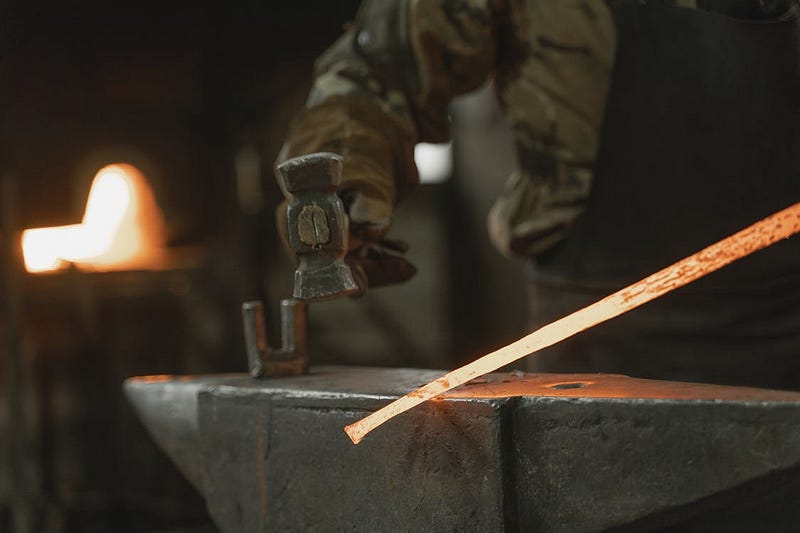
The blacksmith’s was on Ivy Leaf Street, which came off of the main square, and it was directly across from the enchanter’s that Cathal had begun to work at a few months ago. Wayfare was a small town, a few hours’ drive away from Camelot, and while it didn’t compare to the city’s sprawl itself, it was a far larger magical settlement than any Cathal had lived in before.
The village he’d grown up in was of modest size, and had primarily been mundane — his workshop, a little way outside of the village proper, had been the most concentrated magical place for miles around, with only one or two personal homes dotting the nearby countryside also inhabited by magical people.
Wayfare wasn’t like anything he’d ever experienced before, every storefront showing magical goods for sale, almost everything handmade if not crafted and customised to order, every home inhabited by magical people, half a dozen languages marking signage — not just English or Spanish or Arabic or Cantonese, or Irish or Welsh, but fae languages he’d never seen before, old tongues that were only used by immortals.
One shop which extended out into the witch’s market, the stalls a natural extension of the store itself, distributed newspapers and sold books that just looking at made his head hurt — the shopkeeper was an angel, and the language’s script was not possible for a non-angel, someone told him, to meaningfully comprehend.
The smith was open six days a week, and whenever Cathal went past he could hear the hiss of steam or the clang of metal on metal. It was after a few months in Wayfare that he first began to peek in to watch the smith at work.
The blacksmith himself was short and plump, bald-headed with a thick beard, and he was absolutely covered in tattoos. Cathal, whenever he allowed himself a glimpse, was simply fascinated. In the movement of his muscles, their tensing and loosening, he could see the blacksmith’s strength, but in the swirl and shift of his tattoos, he could see his magic.
Their spiralling lines and curves, which intersected with one another and wrapped themselves around his limbs and the breadth of his body, would move and shift as though they themselves were alive when the smith used them to channel his magic, the black ink beginning to glow all the blacker with power, even as more light glinted off his hammer or whatever other tool he was using.
Even when he was doing his paperwork or standing away from the forge, Cathal would sometimes see their complex pattern move and shift — whether it was simply the natural movement of his skin that made them appear to be in motion or the designs themselves animated by magic, he didn’t know.
He knew that they were beautiful — fascinating, too.
He was embarrassed, really. That he found the smith so fascinating, that he so much wanted to watch, to observe. It wasn’t just the magic itself and the way that the blacksmith channelled it that intrigued him, after all. It was the smith himself, the way that his dark eyes glittered and reflected the light from the fire, the weight and thickness of his muscles, the shape of his lips, his hands.
He could never watch for too long.
Occasionally, the blacksmith would turn to see who was there and he’d hurry away, but one day the smith caught him looking, and smiled. He looked at Cathal, smiled wider, and turned back to his work.
Cathal started watching a little more obviously, after that, poking his head around one of the open doors or windows into the darkness of the forge, the old stone-built building. He watched the smith work as he came past, when he went to work, and when he left, too.
It exhausted him, working.
Three days a week was enough, sometimes, to leave him dead to the world for the four days in between, if he was working on anything too heavy, too involved, but that was the nature of the thing, and he didn’t know that he could bear to be without it.
He was tired enough sometimes that just being on his feet outside the blacksmith’s made him ache to his bones, made him feel like he was about to fall over.
One Friday, when he left work at a slow pace, relying heavily on his cane, he saw that there was a new bench outside the blacksmith’s. It was not a particularly large or stately thing: it was simple, varnished wood with copper frames, resting under one of the wider windows.
It made him smile, to see it, and for the first time Cathal got up the courage to move through the doors and inside. It was dark, but despite the heat that radiated from the open mouth of the forge, the rest of the air was cool, like being underground.
“There’s a seat behind you, next to the counter, for people to wait,” said the smith, not stopping the movement of his hammer, its head landing hard against the orange glow of the metal molten upon his anvil. “Or watch.”
“Is that bench outside for me, too?” asked Cathal.
“It’s for anybody.”
“Oh,” said Cathal, suddenly embarrassed again, but the blacksmith met his gaze, and he smiled. It was a wonderful smile, soft and warm.
“Anybody who wants to sit,” he added. “So far, that’s just you.”
He nodded to the seat by the counter, an old armchair with a worn, comfy cushion in its seat. It was singed in places, but it looked tremendously comfortable, looked like the sort of chair one could sink right into.
“Perhaps not today,” said Cathal. “I just… I wanted to ask your name.”
“Tekan,” said the blacksmith. “You?”
“Cathal.”
“Caw-hol,” repeated Tekan slowly, narrowing his eyes even as his smile grew wider. “Is that spelled how it sounds like it should be?”
“No,” said Cathal, with a rueful smile. “It’s Irish — C-A-T-H-A-L.”
Tekan’s laugh came from his stout, rounded belly, which he smacked one broad hand against as he let it out, and he shook his head. “Of course,” he said. “It is never easy.”
“Tekan is… Arabic? Farsi?”
Tekan raised his bushy eyebrows in surprise, but he seemed very pleased, and he nodded his head. “Mm,” he rumbled approvingly. “Closer than some people would guess. It’s Kurdish. You like to watch me work?”
“It’s beautiful, the work you do,” said Cathal. “Strength balanced against delicacy — it’s always a pleasure to watch a skilled man at work. Don’t you think?”
“I do,” said Tekan, nodding his head. “There’s a hypnotic appeal in expertise, wherever we may find it.”
Cathal wanted to stay, to linger longer, but his bones ached, and he knew if he sank into the armchair that he’d never get out of it without falling asleep first. “I should go,” he said. “See you.”
Tekan nodded to him as he went back to work, and as Cathal made his way out, his joints letting out creaking complaints, he found that the air outside the forge was heavy, too warm, and distantly oppressive.
He collapsed in a heap in the back of the taxi.
He slept a lot, the next few days — he’d been working a lot of magic under his hands, and as much as the work gave him pleasure, it was both physically and mentally involved. In the aftermath, he felt drained.
After he finished his first day back, he sat on the bench outside Tekan’s shop, leaned to watch him work. The blacksmith glanced at him, leaning forward to look around the open door, and he smiled, but said nothing. Cathal rested a while with his head leaning on the stone, hypnotised by the smith’s strength and focus.
It was almost soporific, the way he moved, the way he worked, his mighty shoulders giving such power to the pounding blows of his hammer at a slow and measured rhythm, and although the sound was loud, Cathal found a certain unexpected beauty in it and its bounce off the stone walls.
On a day with heavy rain, some weeks later, he went inside again. He hurried in before he could change his mind, his cane in his hand, and sank into the armchair.
Tekan wasn’t working the forge, but was on his feet behind the counter, making notes in his shop book. His glasses had complicated copper frames, and Cathal looked between them and the copper ornaments and wind catchers the smith had hanging for sale, thought about the copper frames for the bench outside, and noted the similarity in the fine delicacy of the metalwork and its curling spirals, its symmetrical geometric patterns.
“I have the lenses made,” said Tekan, answering the question before he asked it, as he took them off, “but the frames they have are always too small for my big head — they dig into my skin.”
Cathal laughed, unable to stop himself.
“You wear glasses?”
He shook his head.
“You have that made?” asked Tekan, nodding to his cane, and Cathal shook his head again.
“No, I bought it second hand. Trying to sell me a replacement?”
He worried that was too rude, but Tekan was already laughing — Cathal thought about the different ways their laughs bounced off the ceiling and the stone walls.
“I make metal staves from time to time, but never a cane before. You work part-time in the enchanter’s?”
“Yes, I work the flower counter.”
“Oh, you do the fresh flowers and the enchantment work?” asked Tekan, his eyes alight with interest. When Cathal nodded, Tekan looked impressed, setting his chin on his hands as he looked over the counter at him. “That’s delicate stuff,” he said. “Complicated.”
“You do enchantment, don’t you?”
“Yeah, yeah, but this is specialised,” he said, gesturing vaguely. “Normal enchantment, you can paint or carve your symbols, but forgework you need the concentration of heat and magic, with your enchantment layered between the metal. It’s somewhere between enchantment and raw channelling, you know.”
“Your tattoos,” said Cathal, and the smith nodded his head, flexing his strong fingers: the swirling, complicated chains and ropes tattooed up the length of his powerful arms moved and shifted like the coils of a shifting snake.
“They let me channel enough raw magic with which to work.”
“Does it hurt?”
“When I started out, learned from my grandfather, my mother, it ached a little. But it was like… Mm. When you’ve been in snow, and you come inside and put your feet in hot water. Cold and burning all at once, but relief, too. It comes naturally to me now — I would feel its absence more than I feel the sensation itself. You?”
“You’re asking if it hurts?”
“The scars on your wrists are spell damage,” said Tekan, and Cathal automatically turned his hands palm down. “I’m sorry. I’ve offended?”
“No, no,” said Cathal. “I’m just shy, I suppose. The scars are from over exertion.” He turned his hands over again, slowly flexing his own fingers, and Tekan observed the movement of the thin, lightning scars much as Cathal had observed his tattoos. “No more active magic for me.”
“You take on something too strong?”
“I developed an autoimmune condition,” said Cathal quietly. “Chronic fatigue, muscle pain, inflammation, all that — after a bad flare up I wasn’t able to work for quite a while, and I didn’t use much magic. I went to cut back the hedge on a nice, sunny day, used the same cutting spells I’ve been using since I was a boy, but it had been months since I’d done anything. I felt like I’d ripped all the blood out of my body at once — it nearly put me in a coma, and I was very lucky a neighbour was passing by at the time.”
“Shit,” said Tekan.
“Yeah,” said Cathal. “But even if I’d known, if I’d gone back little by little, I probably still couldn’t have returned to channelling the way that I used to, as a gardener. My body no longer reacts to strain as it once did.”
“I’m sorry,” said Tekan seriously. “It hurt your leg?”
“My legs are fine — I just get tired easily, that’s all. Standing unassisted for long periods isn’t so easy. Benches help.” He offered a small smile, and Tekan’s own returned.
“You tired today?” he asked.
“I’m tired every day,” said Cathal honestly, and Tekan chuckled.
“Very tired?” he asked. “Too tired to hang around an hour, ’til the shop closes up at seven? Then walk next door, have something to eat?”
Cathal watched the blacksmith a moment, his lips shifting. “Too tired to sit in a chair and watch you work?”
“Watching me is very involved, very stimulating,” said Tekan confidently. “I am without peer — my expertise is very exerting, even to observe. It could be too much for you.” He was teasing, but there was a genuine light in his eyes that made Cathal feel comfortable and warm, a sort of sweetness.
“I think I might manage it tonight,” he said.
He wondered if Tekan would make conversation after that, but he didn’t — it was what had worried him about stepping inside for so long, but the smith didn’t keep up the talk. Cathal leaned back into the embrace of the armchair, just as comfortable as it looked, and almost dozed as Tekan returned to his work.
Heat flared regularly from the forge, coming in waves that touched his cheeks and his hair, and the loud clatter and bang and hiss of steam soothed him as he imagined waves soothed sailors.
He didn’t fall asleep, not quite, but there was an hour or so of genuine rest.
After they ate, the smith didn’t suggest drinks after, or that they keep talking. He must have been able to see that Cathal was flagging, because he said, “We can do this some Sunday, on a day where you’re not too tired.”
“If you like,” said Cathal, his cheeks feeling warm, and when the smith offered his arm, he took it, leaning his weight on the smith’s shoulder.
The tattoos tingled where they brushed Cathal’s skin, a whispered promise of things to come.
Leave a Reply