Final installment. A distinctly queer adventure full of internal conflict ensues when a gentleman and a sailor are captured by pirates.
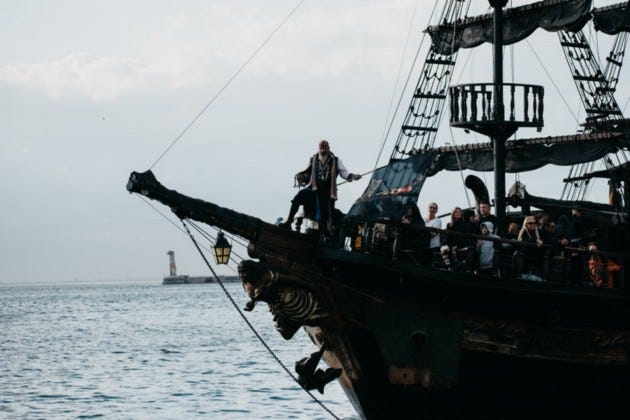
A little bit of adventure, romance, and queerness in the 18th century Mediterranean!
An adaptation of my TweetFic, Gerald Poole & the Pirates.
Part I | Part II | Part III | Part IV
Content warnings: consent issues throughout and sexual threats, violence, period-typical racism and homophobia, ableism, self-esteem and identity issues.
They traded some ways east of Tripoli, and it didn’t occur to Gerald really, seriously, that neither of them had tried to escape until they were already sailing north again. He thought about asking Wicks about it, ask why he hadn’t even suggested it, assuming he had thought of it where Gerald hadn’t, but the matter wasn’t currently foremost in Gerald’s mind.
“You could come with me,” he said, and Wicks glanced at him.
“What?”
It was late in the evening, and Gerald was sitting up and not reading his book, his legs entangled with Wicks’ on the bed. Wicks’ legs were very warm.
“To my aunt’s house,” said Gerald. “To pick olives. If you can’t go back to sea, if the navy won’t take you back.”
“Oh,” said Wicks quietly. He shifted his position on the pillow, curling his face more into Gerald’s side, his blunt nose tickling at him, his breathing hot. It should have bothered him, really, but it didn’t, not at all. He liked Wicks’ head beside him on the pillow, Wicks’ arm around his thighs, even though he couldn’t see Wicks’ face, the expression on it. “Poole, I like the sea,” he murmured tiredly. “It’s my place, a ship’s deck.”
“You talk an awful lot about people’s place, as though it should matter.”
“For some of us, Poole, it does matter. Not everyone has the luxury of setting aside the destiny strangers assign to us.”
“Why, because you’re not rich?”
Wicks sighed, hard, and he leaned back from Gerald’s thigh, looking up at him. “Poole,” he said. “You do see the differences between us, don’t you? The differences between my hair and yours, my nose and yours, my skin and yours?”
“But you’re English,” said Gerald. “As English as I am. It’s not as though people ought see you as anything less than I am.”
“You think the average sailor doesn’t look at me and see a man not so dissimilar to the man on the market block?”
“It’s not as if Britain’s made slavery legal, and we don’t recognise slavery abroad — you’ve the same rights as I do, and should. Even escaped slaves have more rights in England than elsewhere — Lord Mansfield blocked them from sending that slave back to Jamaica once he reached the asylum of Britain’s shores.”
“James Somerset,” muttered Wicks.
“My father’s an abolitionist,” said Gerald, “and he wrote an essay about — ”
“Good for him,” said Wicks loudly, sharply, and Gerald shut his mouth, seeing Wicks’ frustration and not understanding what he was meant to do to assuage it, what he was meant to say, when Wicks wasn’t a slave, had no relation to slaves, and had been in the navy — that meant he was his own man, didn’t it? No matter the colour of his skin, he was a sailor as any other man.
“What about me?” asked Gerald lowly. “Where do you think my place is?”
“For now, I think right here will do,” said Wicks, and pressed an infuriatingly lovely, painfully chaste kiss to Gerald’s hip. His eyes were closed, and he seemed on the verge of returning to sleep.
Gerald, upset for reasons he couldn’t hope to put into words, set his book aside and blew out the light.
* * *
Jack had excused himself from the table down on the sand, where they were roasting two goats over a fire, and he stood on the top of the hill, resting his elbows on an old section of wall. The island was a strange one, not one that he’d ever seen charted, and it didn’t make sense in his head, where they were — but they were undeniably on land.
“I wondered where you were,” said Thwaites in mild tones as he came up the last of the steps, and Jack glanced back at him. He was stripped down to his shirtsleeves with them rolled up to his elbows, and his vest and shirt were both worn open, such that he could see huge sections of his skin. There were tattoos on him, of course — the Argo on the back of his neck, the Pisces constellation over his heart, and more and more tattoos than that, a few dozen of them.
His hair was tied up in a loose and messy bun, a few strands free and falling around his shoulders, and it framed the handsome lines of his face; in the warmth and brightness of the sunlight, Wicks could see the star-like glitter of the honeydrops in his eyes.
“Your hair’s getting a little longer,” said Thwaites when Jack said nothing. “I’m told you’re nearly out of that awful pomade, thank God — you needn’t dread your hair if you don’t like, but if you don’t want it cutting, I’m sure one of the others can help you work. Creed’s a dab hand with braiding, even for short hair, or he could at least do some twists for you.”
Jack set his jaw, pressing his lips tightly together and pushing his palms firmer against the stone underneath him. “I need to pomade it,” he said quietly. “Or it gets tangled.”
“Do you comb it?”
“I can’t get a comb through it unless I pomade it,” said Jack irritably, and Thwaites smiled at him as he came to stand at his side, and undid the ribbon in his hair, shaking his head. His hair fell around his shoulders as it often did, thick and silky and with a gentle wave toward the end of it.
“I’m not criticising you, I just think it must be uncomfortable, that’s all. My mother taught me to take very good care of my hair,” said Thwaites, reaching around and pulling it so that it fell over one of his shoulders instead of both, and Jack looked at the ink on his neck, and the dappled scars there too from one violent encounter or another.
“My mother died when I was four,” said Jack in a low voice. “She was very ill all my life — complications from my birth.”
“You don’t remember her?” asked Thwaites, looking out over the horizon and the shining blue of the ocean swells.
“Not as I remember other things,” said Jack, although he had no real idea why he was answering, why he felt so compelled to answer. Thwaites beside him was warm and seemed tremendously solid, and Jack was torn between wanting to stand here beside him forever and to pull away from him. “I remember… the scent she wore, a French scent, the texture of the dresses she wore. I don’t remember her face, but my father did commission a small portrait.”
Thwaites chuckled, and Jack glanced at him.
“What?”
“He thinks you’re poor, that’s all,” said Thwaites, his lips twitching in amusement. “Most of the men have assumed the same, that you’re just a run of the mill lad who signed on from the docks in Bristol. Your father is Admiral John Edward Wicks, isn’t he?”
Jack pressed his lips together, and then nodded.
“Money isn’t everything,” said Thwaites quietly. “It doesn’t change how people think of us, the assumptions that are made of us.”
“All of my father’s wealth is in property,” said Jack. “Perhaps I’d agree with you if I had any share of my father’s money and didn’t have to make my own way.”
“Want me to have a friend kill him, get you your inheritance as soon as possible?” asked Thwaites, and Jack gave him a horrified look, but Thwaites was laughing — what sort of man joked about that? Well. The sort of man that had killed his own father, Jack supposed.
“You know what Poole was telling me last night?” asked Jack, feeling the urge to tell him about it suddenly burst in his chest, and Thwaites arched his eyebrows.
“Go on.”
“His father is a member of the abolitionist movement,” said Jack, and Thwaites started laughing, putting one of his beautiful hands over his mouth.
“Oh, bless his stupid little heart,” he murmured. “He just brought that up unprompted?”
“Not exactly. But he thinks — he really does think it’s about money, you know, or luck. That just because a few people say something ought be one way, it is that way. He’s… He has no idea what he has at his fingertips. His wealth, the family he comes from, the influence he could so easily command, and he throws it all away to whore himself out to every passing man, never so much as makes an attempt to control himself.”
“Control isn’t innate for all of us,” said Thwaites, giving a slight shrug of his shoulders. “I’ve gotten better, the older I get, but I can be…” He huffed out a small, self-deprecating sound. “Suffice it to say, it’s taken me quite some years to get my temper in order, and Paul still has to pull me back from the edge at times. I see a lot of myself in him.”
Jack looked down at Poole, who was laughing his pretty little head off as Creed reached out and adjusted his posture, kept moving his elbows, his waist, tipping up his chin. Poole did a plié, and then laughed when Creed said something else, and then the two of them were wrestling.
Jack raised himself up on his feet, ready to go intervene — Creed was twice Poole’s size easily, and could easily do him harm just by accident — but then Poole did something that Jack couldn’t quite follow with his eyes, and threw Creed bodily onto the ground. Creed landed hard on his back with a shout of surprise more than pain, and Poole looked down at him.
Jack stared, his mouth open, and heard Poole’s cry of, “Oh, I’m sorry, Julius!” and “Are you alright?” as he rushed to help him up, but Creed was laughing so hard from his place sprawled on the sand that he couldn’t concentrate enough for Poole to pull him to his feet.
“Quite the mystery, isn’t he?” asked Thwaites in mild tones. “Sweet little thing isn’t violent by nature, but he knows how to defend himself.”
“Creed is a giant compared to him,” said Jack softly.
“Oh, it’s all about using a man’s weight against him, tipping him off his balance,” said Thwaites. “It’s really all the more impressive that he can do it with Creed — he’s got an impeccable sense of balance, what with all the covert observation of the ballet he used to do when he was still in New Orleans.”
“I can’t cope with him,” said Jack quietly. “I know he isn’t as delicate as he looks, but he’s impossible to speak to about anything — ignorant of the world as he is, so entirely naïve, so certain that everyone must have it as easy as he does.”
“You think he has it easy?”
“If I were embroiled in half of what he seems to have been, I’d have been hanged a dozen times over.”
“You’re quite right, of course,” said Thwaites mildly, “had he skin like yours or mine, he’d never have been such mercy from any justice — but he does suffer things you don’t. I would point out that for all your struggles, Lieutenant, people have actually made attempts on his life half a dozen times. Can the same be said of you?”
“What are you talking about? Who’d make an attempt on his life?”
Thwaites laughed, and patted his shoulder. “Oh, the both of you do make me laugh,” he said amusedly, drawing away from him and starting to make his way back down the steps. “I don’t know that there are two men the world over quite so stupid as you two. He talks, you don’t listen, you mutter a few words, he can’t read between the lines, you get angry that he can’t divine the parts you were too cowardly to say — and then instead of asking you about it, he runs off to sulk in my lap.”
Jack had no idea whatsoever what to make of that, and he came to follow after Thwaites down to the bottom of the hill.
Poole was talking in a rapid language that wasn’t French or Spanish with a few of the other sailors, and judging by Creed’s blank expression as he looked between them, he couldn’t follow it any more than Jack could.
Poole seemed upset, had his hands clenched at his feet and was stamping his foot, which only made the sailors laugh harder, and then Poole said something so sharp that all three of them went quiet, staring at him.
One of them said something else, and all three of them laughed — and Poole’s eyes flooded with tears.
Thwaites broke into this conversation now, saying something smooth and idle and easy, and when Poole opened his mouth, Thwaites grabbed him by the hair and pulled him closer, wrapping one arm around Poole’s shoulder.
“These delightful men, Poole, are rather jealous of your skill, I’m afraid,” said Thwaites softly. “Were any of them able to dance as you and Creed do, perhaps they wouldn’t be quite so unpopular with the ladies when we make port.”
Poole, teary-eyed and so red in the face he looked ready to explode, said something loud, and one of the sailors lunged for him — before Thwaites could grab him, Poole had kneed him in the crotch, and he went down to his knees with a sharp sound of pain, although Thwaites hauled him back before he could do any more damage.
“I’ll deal with you three later,” Thwaites barked, and Jack followed after them as Thwaites pulled Poole aside to sit, and Poole dropped down onto the chair that was beside Cotton’s workbench as he carved a piece of driftwood with a face.
“Alright, lad?”
“No,” said Poole. “I’m basically a girl, and I cry like one, and dance like one, and I’m a sodomite.”
“None of that’s new,” said Cotton. “Best own up to what you are, lad, and just be better at being it than they are at being them.”
Poole, wide-eyed and wet-cheeked and sniffling, stared up at him.
“Or just stop crying,” said Jack. “Is that what they were saying to you, that you look like a girl? Do you think it helps to burst into tears?”
“You think I cry like I do on purpose?” demanded Poole.
“Do you see me cry over every insult bandied in my direction?”
“No, but I never see you smile, either,” said Poole scowlingly. “You’ve all the emotional range of the Mechanical Turk, except I expect you’re as easy to flounce at chess as you are at cards.”
“And if you weren’t so deficient you could do a thing other than play chess, cards, and doctor, perhaps they might have cause to call you something other than a sodomite or a girl.”
“Mr Cotton is right,” said Poole wetly. “At least I know I’m a sodomite and good at it — you don’t have the slightest idea what you are.”
“You struggle to understand my identity because it doesn’t revolve around cock, Poole,” said Jack. “That’s not the same as me not knowing what I am.” There was more scorn on what than he intended, and Poole stared up at him, his lips parted, his eyes still wide. “You’re just too stupid to — ”
“Fuck you,” hissed Poole, and stood to his feet, his fists clenched tight at his sides, his lips curled in a snarl, and a part of Jack thrilled to see him like this, so angry he wasn’t crying any longer, even though just as much of him was genuinely a little intimidated despite himself. “You think I’m stupid? Why? Because I think other people can and should be halfway decent? Because it upsets me when people call me a whoreish little bitch, whether they do it in Hungarian or some other tongue?”
“Is that what it was? Hungarian?” Jack asked, and Poole stared up at him. “Where did you learn to speak Hungarian?”
“Do you speak any language other than English?” demanded Poole.
“French and German.”
Poole spoke so rapidly that it was all a blur of noise, and although after a few seconds Jack knew that it was French, knew enough that Poole had called him vous instead of tu, called him cher, he couldn’t pick out any of the other words; when Poole followed it up with a volley in German, still using a formal pronoun, Jack set his jaw.
“Don’t be so superior, Poole,” said Thwaites. “I expect Lieutenant Wicks reads very well — not everyone has the opportunity for practice as you’ve had.”
“What, no catty comment about how I can’t read?” demanded Poole when Jack said nothing, and Jack pressed his lips hard together.
“Make up your mind,” he said coolly. “Do you want me to be cruel to you, or not?”
“I just want you to think I’m worth something,” said Poole dully, and somehow it was worse now that he wasn’t crying. “You keep saying I’m a stupid useless whore even though I’m good at all sorts of things and I’ll give everything a try, because coincidentally anything I happen to be good at is something you don’t think is worth being good at.”
“Everything I say and do, coincidentally, is about you,” Jack retorted.
“If it’s not about me, why do you have to fucking look at me like you do?”
“I’m not always looking at you!” snapped Jack, “sometimes I’m just fucking looking!” He’d raised his voice, something he always tried not to do, because he knew how uncontrolled it made him look, how people found it “intimidating” no matter how justified his anger was or who shouted at him first.
He regretted it, inwardly cringed, almost wanted to apologise even as he did it because he could just envision Poole cringing away from him — but when he looked, Poole hadn’t even flinched.
“Just say that then,” said Poole. “I don’t fucking know the difference, do I?”
“You don’t know the difference between — ” Poole’s eyes were flaring with heat, and Jack snapped his jaw shut. “Fine,” he said. “Fine. There’s nothing wrong with you being a sodomite — I’ve not the slightest problem with the men you fuck or the men that fuck you. If I’d understood what the Hungarians were saying, perhaps I’d have intervened myself. Do you want me to go punch their lights out?”
“Yes, please,” said Poole immediately.
“No,” said Thwaites.
“I wasn’t going to do it!” said Jack.
“I didn’t want him to,” said Poole, his lips shifted into a small smile.
Thwaites and Cotton shared a knowing look, which Jack resented.
“Remember what I said, lad, about just telling him what you mean?” asked Cotton.
“Oh, I prefer that,” said Poole. “When people just say things instead of faffing about with… with implications.”
“That’s because you can’t follow implications,” said Jack.
“Yes!” said Poole, stamping his foot on the ground and putting his hands on his hips. “You know that.”
Jack stared down at him, putting his lips together. Poole wasn’t as fragile as he looked, Jack knew, even like this, pale and teary-eyed and overwhelmed, and yet —
And yet.
Of the two of them, it really wasn’t Poole who was the stupid one, because Jack felt raw with a sort of agonising want — but of course, what he didn’t want was to be Poole’s kept fucking man, isolated on an olive grove with him and dependent on his mercies and his charity. It would be different, if he had his own money, but he didn’t, and wouldn’t.
Poole wiped his eyes.
“Hey,” said one of the Hungarians. Creed’s hand was on his shoulder, and he looked nervous.
“Attila,” said Poole, and then raised himself to his feet, shifted his shoulders, and smiled. He said something that Jack couldn’t understand, but it was flirtatious judging by the way that Attila’s mouth dropped open.
Attila said something, slightly harsh, seeming more flustered than angry — Poole replied with a sort of delicacy and a shrug of his shoulders, his voice almost a purr that sent heat flooding between Jack’s legs.
“You serious?” asked Attila.
“Why?” asked Poole. “Scared to give it a try?”
Creed had taken his hand off of Attila’s shoulder, making a face, and Poole smiled at all of them before he went to keep pace with him, sliding his hand around Attila’s arm.
“Well,” said Thwaites, smirking. “One can’t say the lad isn’t a master of resolving conflict.”
“What, with his arse?” demanded Jack.
“If you understood Hungarian, lad, you’d know it was his mouth,” said Cotton.
“Do you think you’re helping?”
“No, but then, I’m not trying to help. I’m just enjoying myself, me.”
Jack looked at Creed. “Did you expect this?”
“No,” said Creed, and then laughed. “I never know what to expect with him. He’s a bit like you that way, Captain.”
“You’re very sweet, Creed,” said Thwaites.
“You’re not going to do anything?” Jack asked.
“What do you want me to do, Wicks? Ask if we can watch?”
“I expect he’d let you,” said Cotton, and Jack rolled his eyes and came to stand at his workbench with him.
* * *
It was a small island with a wide beach and cabins hidden up amidst the trees, and for two weeks as the date they’d set for the exchange approached, Gerald slept on top of Wicks. It was often on beds laid out under the trees, so that they could see the stars — the air was warm and humid, and remarkably heavy on the skin.
Thwaites showed him a cicada, held it delicately as it wriggled in his palm and beat its wings, and he pointed out to Gerald the segmentation of its body, the stained-glass appearance of its wings, the different pieces of its legs and the way they were separated and the shape of its feet, and its black beady eyes.
They were so much louder, the cicadas singing all together, than Gerald could ever have thought.
He touched himself one night when it seemed every soul on the island was asleep, muffled his gasps into his own shoulder, and Wicks reached out and grasped his wrist.
“Wicks,” Gerald whispered harshly, feeling drawn tight as a bowstring, so close he could taste it.
“Not next to me,” Wicks complained. “I can’t sleep. Didn’t Atilla give you what you wanted?”
“No, I just sucked him off!”
“Well, you should have negotiated better terms. Let me sleep.”
Gerald let out a growl of fervent frustration and rolled over to go back to sleep, his cock pinned beneath him.
“Just because you’re made of stone,” he mumbled into the bed.
“I’m not,” said Wicks, surprisingly soulfully. “Or I’d be able to sleep through it.”
“Then — ”
“No, Poole,” said Wicks, almost desperately. “I can’t… be the way you are.”
Gerald swallowed hard, and did his best to go back to sleep.
The captain had set a two-week window.
The first day passed by and Gerald felt unwell.
The first week passed, and he was unwell — Wicks rubbed his back after he’d finished emptying his stomach.
“Will you kill us?” he asked Thwaites on the thirteenth day. “You mustn’t kill Mr Wicks. He’s only ever been a good sailor and in any case he was good on this ship too and even if he couldn’t join your crew there’s no reason you shouldn’t just drop him off somewhere.”
“Poole,” said Thwaites, “do you see this book in my lap? Do you think I am holding it for decoration?”
“I don’t care if you kill me,” said Gerald, “but it wouldn’t be preux to kill Wicks, Captain, just for the crime of being next to me — and he’s, he’s already had so many struggles apart from me, you know, being in the navy and being ill-treated just for his not being a white man, and wouldn’t it be awful of you, really, to cut his life short after all that? Wouldn’t that make you just as bad as the navy men who’ve mistreated you, when Wicks has never done a thing wrong in all his life, and been overlooked and poorly treated at every other turn?”
Thwaites stared at him a few moments, and then said, gesturing with the book, “I am reading it, in fact.”
Gerald groaned, and walked away.
Wicks was sitting on a bench, braiding twine into a thicker rope. His hands, which were big and not incredibly delicate, struggled a little with the work, but he rallied to the task and kept moving anyway, such that the rope ended up good and strong anyway.
“Did Julius do your hair like that?” asked Gerald, and Wicks gave him a sidelong glance as Gerald dropped onto the bench — or, more accurately, the old log — beside him, straddling it and dropping his face against Wicks’ shoulder, looking up at his hair. It looked nice like this, no longer thickly pressed down to his scalp with the pomade oil — they’d washed it out, and Wicks’ hair was done in neat little twists now, so that you could see the beautiful thickness of his curling hair, all its natural bounce and life.
“Mr Creed,” said Wicks firmly, “helped me with my hair, yes.”
“He’s good at everything,” said Gerald quietly. “I wish I could be good at half the things he’s good at. Do you think you’ll grow yours out like his?”
“No, I don’t think so.”
“Why not? His hair’s beautiful, don’t you think? I can’t grow my hair very long at all — it gets to about this length and then just stops, really, and grows all messy and drab.” Gerald reached up, running a hand through his hair. “Of course, I’ve had bits of it pulled out enough, with one thing or another — I expect it thinks it knows better than to grow any longer at this point. You know, keep itself out of danger.”
Wicks was giving him one of his funny looks, and Gerald put his hand back down, resting his cheek on his upper arm again.
“I have to pomade my hair in the navy,” said Wicks quietly, so quietly Gerald really did have to strain to hear it, “because I have bad hair.”
“But your hair is — ”
“I know what my hair is,” Wicks interrupted him, and Gerald closed his mouth. “They call it bad hair — they mean that it’s not like your hair. That it’s not thin and flat and straight: it’s too thick, too curly, too much like wool. The only way I can get away with it not being called a rat’s nest is to pomade it, and wear my cap as much as I can.”
“Oh,” said Gerald. “There’s nothing you can do about that, I suppose.”
“No, Poole.”
“And they’d never let you have it like this, or in long dreadlocks like Julius.” When Wicks gave him a look, he corrected, “Like Mr Creed.”
“No.”
“Would you like it like his, if you could?”
Wicks opened his mouth, closed it. Said, “I don’t know that there’s much point in thinking about the coulds, Poole, when I can’t.”
“Same as how you can’t be with men, no matter that you’d like to,” said Gerald.
“I suppose,” said Wicks after a moment, and Gerald leaned into his shoulder for the last time, and stayed there now.
“I’m sorry,” he said. He wanted to say more, to really say something that would make Wicks feel better, to comfort him, but he didn’t know the first fucking thing about the navy, let alone navigating it in such a way as to get people to be less cold, less awful, and he knew by now that trying to comfort Wicks more than often just ended up making him more upset.
“… Me too,” said Wicks, finally, and kept braiding his twine.
* * *
On the next day — the fourteenth day of the window Thwaites had set — white sails showed on the horizon.
Gerald felt a burst of impossible relief followed by a sudden, crushing emptiness.
They all dressed up to go down to the beach — the vessel itself anchored some ways off the shore, and coming ashore in a rowboat was not some agent of Gerald’s aunt’s that he’d never seen before, but to his delight and surprise, his elder brother, Percival.
“Good Lord, Gerry, look at you,” said Percy as came to meet them, cupping his cheeks and pushing his head back to examine him. “You’ve skin like leather!”
“It’s from the sun,” said Gerald helpfully.
“Your poor hands, look at these callouses!”
“From rope, mostly.”
“You’ve put on weight,” said Percy, wavering between approval and concern.
“It’s muscle.”
“All these years, and I’ve never seen you in such an extreme condition whilst still being so… intact.”
Gerald frowned up at him. “What’s that supposed to mean?”
Percy inhaled, and he looked from Gerald to Thwaites and Cotton and Wicks, and then back down at him. “Gerry, not that I’d ever doubt you,” he said, fixing Gerald’s collar although Wicks had fixed it quite firmly in place, “but this is an actual kidnapping, and not some sort of strange sex game you’re playing with these men, isn’t it?”
“Oh, good,” said Thwaites. “I see you know Mr Poole’s proclivities quite well.”
“You’ve hearing like a bat,” snapped Gerald, turning about to look at him, to which Thwaites shrugged his shoulders. “Percival, this is Captain Thwaites and his quartermaster, Mr Cotton — dastardly pirates, they are, and my captains. And this is Second Lieutenant Wicks, who came with me. Captain Thwaites, this is my brother.”
“Hullo, chaps,” said Percy thinly. “Gerry, I have rather a lot of money back on that ship. Am I giving it to these men or not?”
“Uh,” said Gerald, rather taken aback by the phrasing of the question and still rather frustrated by the implication about his proclivities, and he looked to Thwaites and Cotton.
“Don’t look at me,” said the latter.
“I really don’t know,” said Thwaites, shrugging his perfect shoulders, his lips curved into an easy smirk. “Is he going to, Poole, or isn’t he?”
“Forgive me for saying so,” said Percy, “but you really don’t seem to have captured my brother very well. He’s not even bound.”
“He’s here, isn’t he?” asked Cotton.
“It’s a great deal of effort keeping him contained,” agreed Thwaites. “Easier to put him to work and walk away from him, I find, than to try some other method — we would have tied him up, but he fidgets terribly, and always finds his way out of his binds.”
“Why are you — For God’s sake, am I your hostage or not?” demanded Gerald.
“Well, I suppose if you go with him and we take your ransom, you are and were our hostage,” said Thwaites, glancing at his fingernails. “If you don’t, I expect we’d have to call you something else.”
“No column marked hostage on the company roster,” agreed Cotton.
“You mean… You mean I can stay?” asked Gerald.
“If you like,” said Thwaites, all casual. “But I thought you wanted to pick olives.”
“They did kidnap you in all honesty at first, didn’t they?” asked Percy sharply, sounding really quite angry.
“Yes,” said Gerald defensively.
“You did fear for your life?”
“Of course!”
“And you charmed them into wanting to keep you,” said Percy flatly.
“Well, I don’t think I did anything particularly — ”
“This is the fucking highwaymen all over again,” said Percy.
“That was years ago!”
“It was last year, Gerry, and they still send you letters!”
Gerald blustered, glancing at the pirates and Wicks, who were all looking at him with variations of horror (mostly Wicks), delight (mostly Thwaites), and irritation (mostly Cotton) writ on their faces.
“Did you bring them with you?” asked Gerald quietly, and Percy let out an irritable noise.
“You want to be a pirate now?” he demanded.
“Do you think Daddy will be angry?”
“I think he’s given up with anger,” said Percy. “I suppose it’s better to be a pirate than a highwayman or a dancer or a gymnast or any of all that — but he would be angry if you got yourself killed, so… don’t.”
“Percy, I’d never!”
“And you should still write.”
“I’d not stop just for piracy.”
“Do you want money?”
“Well,” said Gerald, “well, they’ve gone to an awful lot of trouble, Percy. How much did Daddy give you for Diane’s dowry?”
Percy looked at him very flatly. “I’m not giving you that much, Gerry.”
Gerald shifted slightly on his feet, and then said, in a slower, more subtle voice, “How much did he give Ben for Flora?”
Percy cleared his throat, his lips twitching as he tried not to laugh. “Well,” he said. “I suppose I can give you more than that.”
“Is this ship ours?”
“It’s John Welch’s.”
“Oh, he’s a terrible bore, Percy.”
“I didn’t call on him for his scintillation conversation, Ger, I called on him because I thought you were actually in grave danger.”
“Would he give my friend Wicks a job?” asked Gerald, and Percy glanced to Wicks, who had been standing straight, hands behind his back, the whole time. “Or would you? He’s quite the hero, Percy, and has been defending my honour and my virtue — ”
Virtue? repeated Percy silently, looking sceptical, and Gerald shoved him in the chest.
“ — and trying to keep me safe, all this time, even though he thinks me really quite annoying.”
“Everyone thinks you annoying, Gerry,” said Percy, “but of course, Second Lieutenant, I’d be glad to introduce you to Mr Welch or write you a letter of recommendation anywhere you like, if you tire of your naval commission. Any man who can handle our Gerald can handle anything the sea would give him.”
“It isn’t necessary, sir,” said Wicks. “But thanks for thinking of me.”
“He calls you sir?” asked Percy from the side of his mouth.
“I was calling you sir, Mr Poole,” said Wicks. “I call him an irritation.
Gerald put two fingers up at him. “Virgin!”
“Whore.”
Percy looked powerlessly between the two of them, and Thwaites said, “And can you believe, Mr Poole, observing this exchange, that we’d ever want to give them back?”
“You’re made of stern stuff, Captain Thwaites,” said Percy, and then patted Gerald’s chest. “Gerry, how many of these men are snared in your trap?
“Two,” said Thwaites.
“One,” corrected Wicks, giving him a glare.
“Percy,” said Gerald, as if butter wouldn’t melt. “I only set traps for rabbits.”
“I should have known it would be something like this,” muttered Percy. “You don’t half give me heart troubles, Gerry — I thought it would be like that mob in Ludlow again and you’d really be quite hurt.”
“Oh, Captain Thwaites is nothing like all that,” said Gerald.
“I’ll sort out the exchange,” said Percy, stepping back. “I’ll be forty minutes — write a letter for Daddy explaining yourself.”
Gerald hesitated.
“Write a letter,” Percy corrected himself, “saying hello and that you love him and that you’re very sorry for all the distress, and tell him it’ll be the last time.”
“Oh,” said Gerald. “Yes, I’ll do all that. Should I try to mean the last part?”
“Why bother? You’ve never meant it before,” said Percy.
As he got back into the small boat again, where the sailors who’d accompanied him looked several shades of baffled, Gerald turned to Cotton, Thwaites, and Wicks, who were wearing similar expressions to the ones they had before.
“Can I kill him now, Ced?” asked Cotton.
“I begin to think, Paul,” said Thwaites pleasantly, taking a puff of his cigarillo, “that you couldn’t manage it if you tried.”
Gerald shifted on his feet. “He’s really blowing the thing about the highwaymen quite out of proportion. They only took me, you see, because I’d been travelling with this caravan who’d picked me up after I offended this Austrian fellow, and then I left to be with the circus for a bit, juggling and doing card tricks, you know, but the highwaymen actually thought when they kidnapped me that I was — ”
Wicks was coming closer, moving across the sand, and Gerald trailed off, looking up at him.
“How many times have you been kidnapped?” asked Wicks.
“Oh, quite a few times,” said Gerald softly. “I believe I have mentioned it, once or twice — you could almost call it a hobby.”
“And those… And people have tried to kill you,” said Wicks.
“Oh, yes, lots of times,” said Gerald, smiling. “I’ve told Captain Thwaites all about a few of the times, and Ju — Mr Creed. It’s really no secret.”
“You’ve never told me.”
“Well, you get angry over stories like that,” said Gerald. “I’m never allowed to tell them at dinner — they’re not for polite company, my father says, and you’re just about the politest company I’ve ever had. Are you — Are you really not going to go with him?”
“No,” said Wicks solidly, his expression unreasonably. “Seems to me I’ve duties still here. With you. If you’re to… I can hardly let you join a pirate crew on your own, with you being the way you are. You need some sort of chaperone.”
“Oh,” said Gerald, and suddenly he was smiling so wide he thought his face might split. “Yes. I — I’ve always rather wanted a chaperone.”
“We’ll have to split the dowry,” said Thwaites.
“We will do no such thing,” said Wicks, and lifted Gerald up by the hips to kiss him.
Gerald gasped and kissed him back, wrapped his legs around Wicks’ waist and marvelled at his strength, felt dizzy and wonderful and as if he might burst. “What about God?” he asked breathlessly against his mouth.
“God can be bargained with,” said Wicks. “I suppose we’ll just have to get married.”
Gerald’s cheeks burned. “Oh,” he said. “Oh, I’ve never been married before.”
“What a nice thing to set marriage apart from everything else.”
“Jack, will you be this horrible and sharp and cutting with me for all our lives?” asked Gerald, almost on the verge of excited tears as he asked, and Wicks laughed breathlessly, and it was really the most wonderful sound Gerald had ever heard.
“For the time being,” said Wicks. “Rest assured, I will do my best to hone the blade with time.”
Gerald giggled, and kissed him again.
When Wicks released him, putting him down on the sand, Thwaites asked, “Is he very good at kissing, Poole?”
“No, sir,” said Gerald. “He’s quite terrible.”
“Gerald,” complained Wicks. “I am no such thing.”
“May I try?” asked Thwaites. His hands were loosely held behind his back — Cotton was now smoking his cigarillo, and sipping heavily from a pocket flask — and he was looking at Wicks very keenly, all the beautiful constellations in his eyes shining in the light.
Wicks stared at him. “A marriage, I might remind you, is between two people,” he said.
“I’ve not the least interest in marrying either of you,” said Thwaites, “although some marriages certainly allow for more than two parties. What I’d like very much for now, Wicks, is to kiss you. What’s more, I think you’d like for me to kiss you too.”
“And fuck Gerald with me too, I suppose?”
“Or fuck you with him,” said Thwaites. “Variety is the spice of life, I’m told.”
“Lad,” said Cotton, “if you really don’t want to, you don’t ha — ”
Wicks dipped Thwaites to kiss him as though the two of them were dancers, and it sent Thwaites’ hat falling to the hand, one of his hands coming up to cup Wicks’ cheek.
Gerald felt hot all over.
“There,” said Wicks, keeping Thwaites tilted backward as their mouths broke apart. “Do you think I’m bad?”
“Young man,” said Thwaites kindly, “you’ve more than enough time to practice.”
Giggling, Gerald managed to catch him before Wicks could drop him on the sand.
“I’m still not splitting the dowry,” said Wicks to Cotton as Gerald and Thwaites began to kiss again, and this time, no one stopped Gerald from undoing Thwaites’ belt.
“If it’s any consolation, Jack,” said Cotton, offering him the flask, “I don’t think it’s the dowry he’s interested in splitting.”
FIN.
Leave a Reply