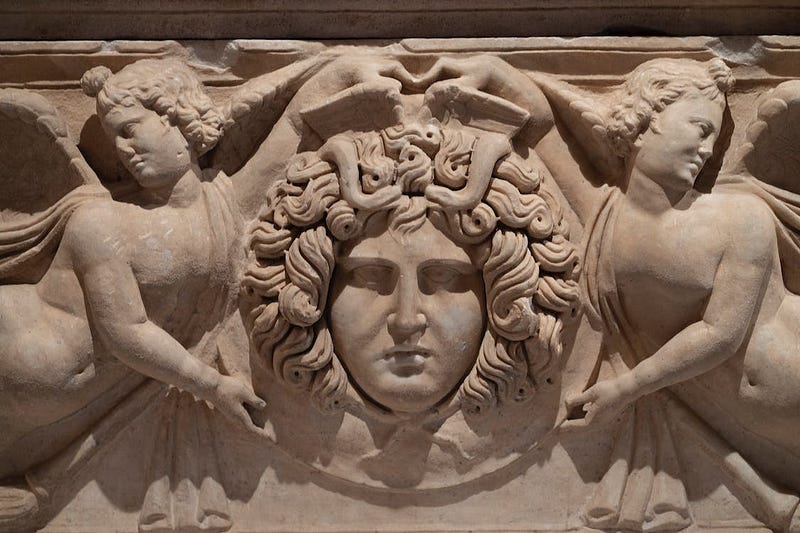
Fantasy short. A snake-headed woman lives in solitude beneath the ground.
1.2k, rated T. CW for non-explicit references to sexual assault.
The gorgon lives alone so that she can be at peace.
She rests in the centre of a labyrinth of her own making, a sprawling network of tunnels made in the hollow spaces beneath the roots of tall trees, and in these she stays, always.
She misses the sun, at times.
Here, lit by lantern light and hidden beneath root and bush and shrouding grass, no one can come upon her by accident, and the signs at each tunnel’s mouth are as plain as plain can be: there is danger here. Do not pass. Do not enter. These tunnels host peril, and what lies within will harm you.
Turn back now.
They do not dissuade everyone.
The gorgon knows well the statues that stand about some of her tunnels, men in their armour turned to petrified stone — men who did not come out of foolishness, but out of a desire to kill a monster, to kill the monster.
Her.
The gorgon has never been a monster.
Once, she covered her body, wrapped her hair, bowed her head in the streets; once, she kept to street edges and walked amongst crowds; once, she did everything she could to avoid the attention of men, drowning herself in modesty as one might drown herself in cool waters, and it was not enough.
She remembers how she stumbled through the city after, still half-dressed, blood on her thighs and tears on her cheeks, until she fell upon the temple steps and begged for mercy.
She hates the gods for what they gave her: if this is mercy, they can’t be trusted with it.
The gorgon covers her body now, wraps her hair, to walk out and check the traps about her home, that she harm no one, that no one recognise her, and goes below again, to where she will once again be untouched and unbothered. Unhurt, and hurting no one.
Now safe, she pulls the shroud from about her head, shadowing the front of her face, and lets free her hair. The serpents hiss softly, relieved to see the dim light once again, and she reaches up, gently touches the heads she can see in her periphery. The amber-eyed snakes press into her touch, some of them closing their eyes as they nudge against the pads of her fingertips, and she smiles.
None of this is their fault anymore than it is hers, and she is gentle with them. She wonders if they would die, if she cut off their heads, but they are a part of her and they are their own selves too, and even if she could, she doesn’t think she could bear to.
Even if she did, she would still be hunted — but then, unprotected.
One day, one of the heroes will succeed, and she knows this. Once more a man will come for her, destroy what he can of her, and triumph over what he has done.
How can it be worse than this?
She stands in the centre of her cave, looks dejectedly at her bedclothes, her scattered chalks and parchments.
Sighing, she puts herself to skinning the rabbit she had caught that morning, and goes between eating it herself and passing titbits to the snakes that make up her hair. It makes her smile, the way they seem to cheer and delight in it, hissing their pleasure and approval.
It is some hours later that she hears the echoing footsteps in the corridor, and she clenches her fists together. She doesn’t want to kill another of them, has never wanted to kill anybody, to harm anybody, even the first man who —
Not even him.
She doesn’t cry, doesn’t sob. The gorgon has never been that sort of woman, unless truly pressed. She wonders if this was what made her a target in the first instance, at times, if they saw a strength of purpose that had to be broken, as they now see a monster in need of killing.
“Go from me!” she calls into the corridor. “Leave now, or perish!”
Her snakes hiss with her, emphasise her words, and their sound echoes in the corridors. The footsteps come closer, multiple footsteps — an army?
Terror surges in her chest, but then she sees the feet at the end of one dirt tunnel, the bodies they are attached to not yet lit by her lanterns.
“Come no closer,” she beseeches. “You will die if you come any closer.”
Two pairs of feet step forward, and her heart aches.
They are young, it seems to her, youths barely older than twenty. One has beautiful hair of burnished gold, thickly curling, like her hair used to be, before it came alive; the other’s is shorter, folded back from his head.
They have no armour, no weapons, no shields, and her heart pangs —
Yet they do not turn to stone, and she soon sees why.
The man has bandages folded around his eyes, and he leans on the arm of the woman, whose eyes shift and move in the dim light but focus on nothing, their pupils subtly changing in size, but not resting on anything. They respond to the light alone, and not much else.
“Are you the gorgon?” asks the young man.
“Yes,” she says, her heart thumping in her chest.
“You must be lonesome,” says the woman.
“Leave me,” she says sharply. She watches these young people’s faces, the hesitation writ there, the frown on his lips, the part of hers.
“We’re sorry to intrude,” says the young man softly. “But they say you are alone here, afraid of those you might harm — they say to meet your gaze is to perish, but my brother has no eyes, and mine see almost nothing. We thought to speak to you.”
“Of what?” demands the gorgon sharply, her snakes hissing with her. Anger had never suited her, and she’s ill-practised wielding it, but the serpents give their aid, at least. “Of what could you want to speak of with me?”
“Anything,” says the man.
“Nothing,” says his sister.
“Whatever people speak about,” he goes on.
“Whatever you like,” she echoes.
The gorgon stares between them, and the sister squeezes the brother’s arm.
“We’ll go back,” she says. “But we’ll come back tomorrow, if you like.”
The gorgon hesitates before she says, “Wait. I — you must take tea, and rest.”
How many years has it been since hospitality has come to mind? The normality of it is so much as to make her feel light-headed, and she leads them each to sit beside the fire, brews them tea, feeds them from her table. They chatter as young people do: they talk of the market, of the price of bread, of the weather, of the trees outside, of a particularly large spider that had crawled over the brother’s foot and made him scream.
(This makes her laugh. It has been so long.)
“Shall we come back tomorrow?” asks the sister, when hours have passed.
“You shouldn’t,” says the gorgon. “You needn’t.”
“We’ll come back tomorrow,” says the brother kindly. “We’ll bring you some flour, if you like. I’m a good baker — you must miss the taste of bread.”
They don’t see it, but the gorgon smiles as she watches them go, a warm glow settled in her chest. She cannot look at their faces, positioned as they are, but her snakes are silent, and she imagines that they are smiling too.
FIN.
Want to check out some more of my work? Here’s a big directory of everything currently available to read; sign up here if you’d like updates, media recommendations, and new works delivered to your email inbox.
Leave a Reply